India's Water Intelligence Platform

Turn Any Water
Meter Into aSmart
Water Meter
Instantly

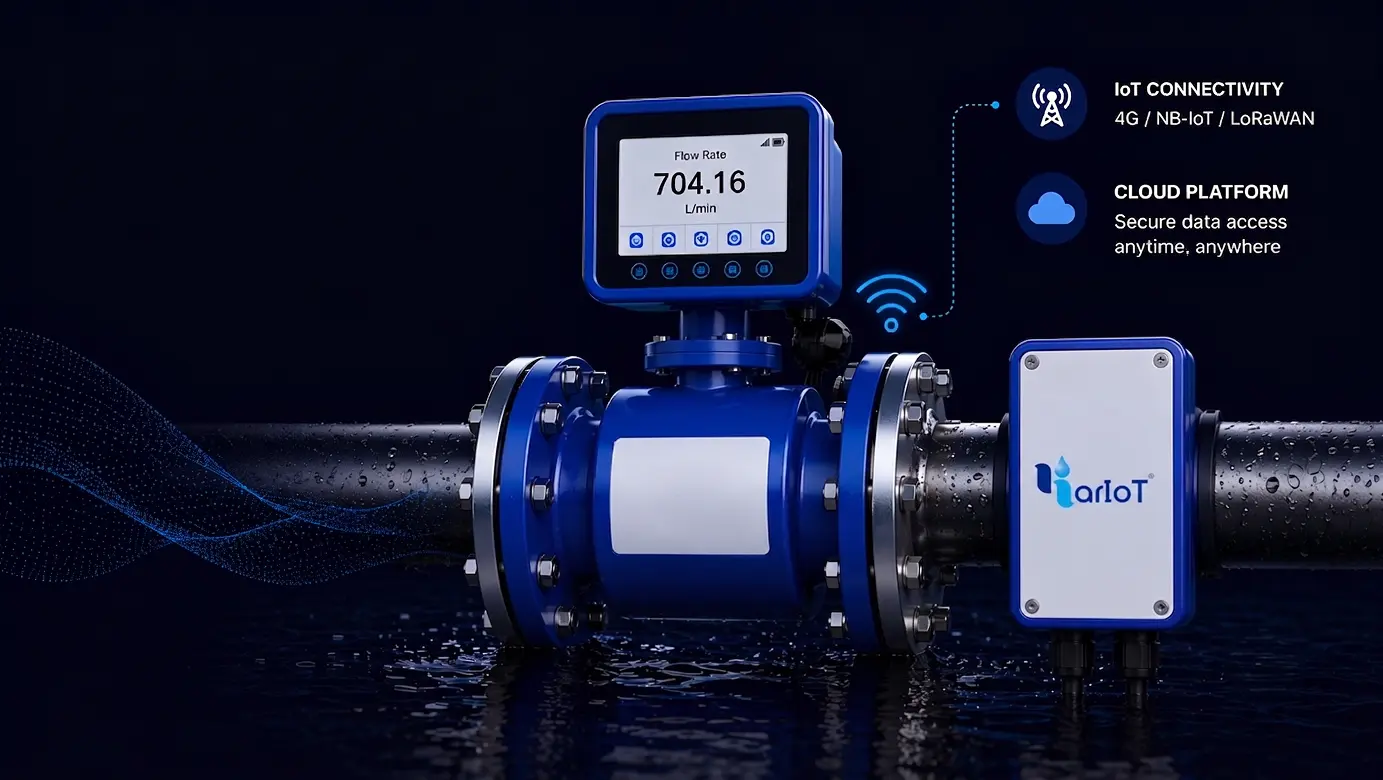
KarIoT gateway and node devices streamline the digitization of Multijet, Ultrasonic,
and Electromagnetic Flow Meters. No need to replace your flowing infrastructure.
Get real-time data, NRW reduction, IGBC compliance all on one platform.

38%
Avg NRW in India
Water lost before billing
₹180M
India Market by 2030
18.9% CAGR (Frost & Sullivan)
500+
Cities in AMRUT 2.0
Mandating smart metering

The Water Crisis Is Real
India’s Water Systems Write Off38%Even
Before They Get Counted

Due to the rapid decline of groundwater levels and the failures of pipelines, India’s water systems are at a breaking point.
Smart water metering is not optional; it is a necessity.

38%

National NRW Average

At 38%, India's average non-revenue water (NRW) is above the global average of 30-35%. Losses in Indian cities like Bengaluru and Kolkata can go up to 50%

21

Major Cities Near Groundwater Crisis

Exceeding the global benchmark of 30-35%, India's non-revenue water averages 38%. In a few Indian cities like Bengaluru and Kolkata, water loss even reaches up to 50%.

600M

Urban Population by 2031

India's average non-collection revenue water stands at 38%, which is higher than the global average of 30-35%. Cities like Bengaluru and Kolkata record as high as 50% NRW.

$3B

Annual Global NRW Loss Value

Worldwide, about 45 million cubic metres of treated water are lost daily, costing more than USD 3 billion each year. Smart meters provide the most economical first line of defence.

4%

India’s Share of World Freshwater

India possesses only 4% of the world's freshwater resources, yet it is home to 18% of the global population. Precise metering is a matter of existence - not an aspiration.

51 → 21%

NRW Reduction: Jamshedpur Case

Using district metering areas and IoT monitoring, Jamshedpur managed to cut their non-revenue water by 30 points, going from 51% to 21%. This achievement is easily replicable across the country.

The KarIoT Advantage
Turn Any Dumb Meter Into a
Smart Meter No Infrastructure
Changes

The solution proposed by KarIoT is flexible, customizable and compact. Our gateway
and node devices easily integrate with existing meters. This provides real-time intelligence and is achieved
without the need for extensive infrastructure changes.

Start Smart Water Monitoring

Existing Meter

Compatible with any multijet, ultrasonic, or electromagnetic flow meter already installed in the field.

Kariot Pulse/Node

A compact node device connects using pulse output, RS485, or Modbus, meaning it’s not necessary to replace the meters.

KarIoT Gateway

The local gateway gathers information from multiple distributed nodes, along with the proprietary local level processing, and transmits it securely to the AWS cloud via NB-IoT, LoRaWAN, or 4G connectivity.

Cloud Processing

Kariot Cloud AI automatically collects data from field devices, processes it in real time, detects anomalies, filters out invalid or junk data, identifies reverse flow conditions, and presents actionable reports and alerts to end users through an intuitive dashboard

Dashboard & App

Management and utilities professionals receive a real-time update dashboard paired with a mobile application that provides users with usage notifications and billing updates.

Meter Technology
Three Meter Types. One Intelligent Platform.

KarIoT integrates seamlessly with all major water meter technologies used across residential, commercial, and industrial sectors in India.

Multijet Mechanical Meters
Made Smart

Multijet meters are the most widely deployed water meters in India's residential sector due to their low cost and durability. While they are accurate mechanical devices, they are completely blind to real-time usage — until KarIoT.

The KarIoT node device attaches to the pulse output port of any standard multijet meter (DN15 to DN50). Every pulse is captured, transmitted, and converted into real-time volume data on the cloud dashboard.

  • Pulse output interface: captures every 1, 10, or 100 litre increment depending on meter class
  • Tamper detection: alerts triggered for magnetic tampering or backflow events
  • Leak detection: continuous flow analysis identifies drips and burst pipes at the property level
  • Auto billing: cloud-generated bills eliminate manual meter reading — critical for apartment complexes and gated communities
  • Tank level integration: combined with ultrasonic level sensors for overhead and sump tank management
  • Supports LORA / NB-IoT / 4G transmission for deep basement and rural deployments
Technical Specifications
Meter CompatibilityMultijet DN15–DN50
InterfacePulse Output (Reed Switch)
Resolution1L / 10L / 100L per pulse
Accuracy ClassClass B / Class C
CommunicationNB-IoT, LoRaWAN, 4G LTE
Battery Life5–7 years (lithium)
IP RatingIP68
Data Interval15 min / Configurable
Tamper AlertMagnetic + Backflow
InstallationRetrofit — No pipe cutting

Ultrasonic Meters for Commercial Precision

Ultrasonic water meters offer no moving parts, high accuracy (±0.5%), and measure both forward and reverse flow. They are ideal for commercial buildings, hospitals, hotels, tech parks, and government facilities.

KarIoT integrates with ultrasonic meters via M-Bus or RS485/Modbus protocols, pulling meter registers directly without any physical modification. The platform supports both static (fixed-path) and Doppler ultrasonic sensors.

  • RS485 / Modbus RTU / M-Bus protocol integration — works with all major brands (Kamstrup, Itron, Badger, Sensus)
  • Sub-second data polling for high-resolution flow profiling
  • Bidirectional flow measurement — critical for recirculation loops and HVAC cooling towers
  • No mechanical wear — ideal for treated sewage effluent (TSE) and recycled water circuits
  • IGBC & LEED documentation support: automated water consumption reports for green building certification
  • Integrated quality sensing: optional pH, TDS, chlorine, dissolved oxygen modules
Technical Specifications
Meter CompatibilityUltrasonic DN20–DN200
InterfaceRS485 / Modbus / M-Bus
Accuracy±0.5% of reading
Flow Range0.01–400 m³/h
Communication4G LTE, NB-IoT, Wi-Fi
Power SupplyBattery / Wired (DC)
IP RatingIP67
Quality SensorspH, TDS, Chlorine, DO, Nitrate
Report FormatsPDF, Excel, API, IGBC
CertificationsBIS, MID compliant

Electromagnetic Flow Meters for Industrial-Grade Accuracy

Electromagnetic flow meters (EMFM) are the gold standard for industrial water management — measuring conductive fluids (water, effluent, slurry) with exceptional accuracy and no pressure drop. KarIoT transforms these field instruments into real-time remote monitoring assets.

Integration is achieved via 4–20mA analogue output or direct digital communication (HART/Modbus). KarIoT's industrial gateway supports multi-point EMFM networks across large process facilities, ETPs, STPs, and water intake structures.

  • 4–20mA / HART / Modbus TCP integration — compatible with Endress+Hauser, ABB, Yokogawa, Siemens EMFMs
  • Bi-directional high accuracy: ±0.2% to ±0.5% — ideal for custody transfer and regulatory compliance
  • Effluent Treatment Plant (ETP) & STP monitoring: track treated water quality and volume simultaneously
  • SCADA integration: OPC-UA and MQTT outputs connect directly to plant SCADA/DCS systems
  • CPCB compliance reporting: automated daily/monthly volumetric and quality reports for regulatory submissions
  • High-pressure and high-temperature variants: up to PN40 rated sensors for industrial process water lines
Technical Specifications
Meter CompatibilityEMFM DN25–DN1200
Interface4–20mA / HART / Modbus TCP
Accuracy±0.2% – ±0.5%
Flow Velocity0.1 – 10 m/s
Communication4G, Ethernet, Fibre optic
Protocol OutputMQTT, OPC-UA, REST API
IP RatingIP68 / ATEX variants
ComplianceCPCB, ISO 4064, IS 1239
Operating Temp-10°C to 60°C
CertificationsCE, ATEX, BIS
Market Opportunity
A $33 Billion Global Opportunity With India at Its Core

Smart water metering is one of the fastest-growing segments in global IoT infrastructure. In India, strong government mandates and rising
water scarcity make it a standout growth market in Asia Pacific

$33.5 Bn

Global TAM

According to Global Market Insights, the smart water meter market is expected to grow at a staggering 26.2% CAGR and 30.4% for the Asia Pacific. As such, the fastest for the world region.

$180.2 M

India SAM

India's smart water metering sector is estimated to hit $180.2 million by 2030, with a robust growth forecast of 18.9% CAGR (Frost & Sullivan), fueled by AMRUT 2.0 initiatives in 500+ cities

$31.6 M

KarIoT SOM

KarIoT’s serviceable obtainable market estimates the potential for retrofit IoT gateway deployments in the top 20 cities in India for residential apartments, commercial buildings, IT campuses, and industrial facilities.

18.9%

India CAGR 2023–2030

India’s smart water metering revenue is projected to grow from approximately $60 million in 2023 to $180.2 million by 2030. Annual unit shipments are expected to increase from 0.59 million to 1.92 million (Frost & Sullivan).

30.4%

Asia Pacific CAGR 2025–2034

The Asia Pacific smart water metering market will be worth $510.9 million in 2024, growing at 30.4% CAGR, the highest in the world. Alongside China and Australia, India is a major contributor.

Government Catalysts

The Jal Jeevan Mission (rural), AMRUT 2.0 (more than 500 cities), Smart Cities Mission (100 cities), BIS smart meter standards (2024), and other similar governmental programs are creating a $5 billion + digitization of infrastructure pipeline until 2030, with metering being an essential component.

Metering-as-a-Service (MaaS)

Chennai (CMWSSB) is one such city investing in the MaaS/DBFOT model, whereby private IoT stakeholders fund, install, manage, and transfer metering systems, resulting in sustained recurring income for companies like KarIoT.

Green Building Compliance
Smart Meters Earn IGBC Points.
Green Buildings Require Intelligent Water Management.

Water efficiency is a required and credit-earning category in the IGBC, LEED, and GRIHA rating systems. With KarIoT’s real time metering, documentation
is automated, sub-metering data is complimented with performance dashboards, and facilitates attainment and maintenance of certifications for tech parks and commercial buildings

Request a Consultation

Why Smart Metering Is Essential for Tech Parks & IT Hubs

India boasts more than 18,850 IGBC registered projects, totaling 15.52 billion sq. ft. Various IGBC rating systems including Net Zero Water, Green New Buildings, and Green Campus place strong emphasis on water metering, sub metering, leak detection, and real time monitoring, especially for IT parks.
Buildings that save 30–50% water against the baseline can earn Gold and Platinum ratings, positively impacting ESG scores, tenant premiums, and regulatory green lights.
KarIoT provides a solution to the compliance maze with turnkey documentation including timestamped data logs, BMS integration, consumption benchmarking, and IGBC reports, which alleviate the operational burden for facility managers and consultants

IGBC Green New
Buildings v4.0

Compulsory water metering as part of Water Efficiency credits translates to 20–30% energy savings and 30–50% water savings. Relevant to IT offices, tech parks, malls, and all new commercial properties.

IGBC Green
Campus

Water efficiency measures, like sub-metering, leak detection, and monitoring systems, as applicable at IT parks, educational campuses, military facilities, and leisure complexes, contribute directly to Resource Conservation credits.

IGBC Net Zero
Water Rating

For office, IT park, and industrial structures, to attain certification, a Water Performance Ratio (WPR) of > 0.75 (approx. net-zero) or WPR = 1.0 (net zero) is required. WPR verification through continuous metering is required, both for certification and for recertification.

IGBC Green Factory /
Green SEZ

Industrial facilities and SEZs under IGBC must demonstrate water efficiency through metered data. KarIoT’s EMFM integration helps automate compliance through the real-time tracking of treated effluent and freshwater usage.

Transform Your Water
Infrastructure with KarIoT

Implement smart water monitoring across residential, commercial, and industrial
facilities with the simplest installation and the highest level of operational transparency.

Talk to Our Experts

How KarloT Earns You IGBC Green Points

[1]Water Metering & Sub-Metering
[2]Leak Detection & Reduction
[3]Baseline Water Consumption Benchmarking
[4]Net Zero Water Performance Ratio
[5]Building Management System Integration
[6]ESG Reporting & Tenant Transparency

Water Metering & Sub-Metering

The IGBC awards extra credits for sub-metering for domestic, HVAC, landscape, and cooling tower functions. IGBC also requires water metering at the building level. With automated daily reporting, KarIoT’s multi-node solution makes this easy.

Leak Detection & Reduction

KarIoT alerts on overnight minimum flows and bursts support leak reduction credits under the Green New Buildings and existing building rating systems. Using AI in consumption profiling helps detect flow anomalies in real time.

Baseline Water Consumption Benchmarking

IGBC needs clear evidence of the percentage reduction against baseline consumption. KarIoT demonstrates historical records and automated monthly actual versus baseline comparisons—formats assessor ready.

Net Zero Water Performance Ratio

The Water Performance Ratio comprised between 0.75 and 1.0 for the Net Zero Water certification by IGBC can be achieved by tracking all alternate water sources. KarIoT tracks all sources of water including treated, recycled and rain water to allow for automation of this calculation.

Building Management System Integration

The BACnet and Modbus TCP outputs from KarIoT easily integrate with BMS platforms like Honeywell, Siemens, and Schneider Electric. IGBC has recognized BMS-integrated water monitoring under the advanced building performance credits. With KarIoT’s multi-node system and automated daily reporting, water monitoring with BMS Integration is made easy.

ESG Reporting & Tenant Transparency

In addition to IGBC compliance, tenants in Infosys, Wipro, TCS, and DLF tech parks demand water consumption details for their Global Reporting Initiative and CDP disclosures. Transparency in water consumption is crucial. KarIoT's tenant-level dashboards address IGBC and corporate ESG reporting compliance

Every Sector Has a Water Problem. KarIoT Has the Answer

From single apartment structures to municipal assistance infrastructure, KarIoT’s personalized and quickly adjustable architecture fits a variety of
requirements, pertaining to water metering, across India.

[1]Residential Complexes & Apartments
[2]Commercial Buildings & Offices
[3]IT Parks & Tech Campuses
[4]Industrial Facilities & Manufacturing
[5]Municipal Utilities & Jal Boards
[6]Water Treatment & Distribution

Intelligent water management for contemporary societies. With KarIoT, you gain:

  • Billing by the apartment, meaning zero disputes
  • Control of tanks and motors is automated
  • Leak alerts the moment they occur
  • Water saving insights
  • Compliance with RERA norms is fully incorporated

KarIoT's services span across malls, hospitals, hotels, and office buildings. They enable precise sub-metering by floor and department for cost allocation and tenant billing.

  • Their platform includes gray water and STP outlet metering for sustainability reporting, and monitoring of HVAC water usage for optimization of cooling towers and chiller loops.
  • Automated reporting fosters compliance with LEED and IGBC standards, while the ability to integrate with CMMS and facility management tools through REST APIs promotes operational efficiency

Smart water metering has successfully expanded to large multi-building campuses, gated communities, and multi-storey housing societies. KarIoT provides a complete view of monitoring across towers, wings, and basements, allowing independent tracking from a single dashboard.

  • The platform streamlines the IGBC Water Efficiency documentation process by automating sub metering reports and baseline comparisons. Furthermore, the platform tracks water made up to the cooling towers and recovered condensate to facilitate compliance with Net Zero Water.
  • Sustainability reporting focused on the Global Reporting Initiative and the CDP, along with tenant-level dashboards, are supported by advanced water intensity (litres per sq. ft. per occupant) metrics. The tenant dashboards support occupiers in achieving their sustainability targets.
  • Rapid response to leaks and anomalies with real-time alerts to facility managers is made possible by reducing operational risk and water damage.

EMFM-based precise monitoring for industrial water systems including Process Water, ETP, and STP. KarIoT pairs electromagnetic flow meters with its gateway for real-time monitoring of process water flow.

  • The system provides inlet and outlet metering for ETP & STP systems as well as important quality parameters like BOD, COD, TSS, pH, and DO (Dissolved Oxygen).
  • Daily automated effluent report generation for compliance with CPCB, state pollution boards, and ZLD (Zero Liquid Discharge) monitoring by balancing the Fresh Water intake and treated water reuse.
  • The system is intended for high demanding applications. It is able to accommodate high pressure of industrial lines up to PN40. Sensor options are ATEX certified for hazardous environments.

Metering Smart water has been implemented in gated communities, multi-storey housing societies, and planned utility-scale additions. KarIoT supports implementation of bulk and boundary metering in District Meter Areas (DMA) for better network segmentation and tracking losses.

  • Integrated with the national AMI deployment support programs like Jal Jeevan Mission and AMRUT 2.0, the platform offers NRW balance analysis, which automatically compares the system input with the total billed consumption to quantify and locate losses.
  • KarIoT provides Metering as a Service (MaaS) under the DBFOT model, which allows for deployment with zero cost. The open API paradigm provides flexible, scalable solutions with minimal disruption to existing SCADA and billing systems.

Water utility infrastructure, smart metering for gated communities, and multi-storey housing societies. KarIoT allows complete monitoring across all Water Treatment Plants (WTPs) with integrated quality sensors for flow monitoring, inflow, outflow and process streams.

  • The platform facilitates pressure zone control, active pressure losses and reduction management, and provides pump station analytics for energy efficiency (kWh/m³ produced water).
  • For users, connection metering is improved with mobile self-service portals for usage tracking, while asset management advanced flow and pressure predictive maintenance alerts provide operational efficiency and reliability.
Everything You Need to Know About
Smart Water Meters in India

Frequently asked questions from facility managers, utility professionals, real estate developers,
and green building consultants about KarIoT smart water metering solutions.

Multijets, ultrasupport, EMF, and other regular water meters only function to measure total water flow in a specific point of use. In contrast, smart water meters equipped with KarIoT node and gateway system capture and transmit usage data to the cloud, at defined time intervals, on a continuous basis.
This capability provides automated billing, real-time monitoring, leak detection, usage analytics, and remote management of the system, circumventing the need for manual meter reading
For Kar IoT, an average apartment complex with around 200 units generally has a return on investment (ROI) within 12-18 months.
Savings stem from removing the costs associated with manual meter readings, reducing water losses, (leakage and theft) which can be up to 25%, improving accuracy on billings, and increasing efficiency on collections. In industrial applications, the EMFM based monitoring has led to further reductions in non-revenue water of 15-40%, resulting in shorter payback periods of 6-12 months.
To achieve IGBC Water Efficiency credits, organizations need verified metering data, functional sub-metering, and measurable reductions against a defined baseline.
KarIoT automates this process by providing sub-meter data by building function (domestic, HVAC, landscape) and baseline performance comparisons, along with daily and monthly consumption logs. Additionally, the platform computes Water Performance Ratios for Net Zero Water certification, works with BMS systems, and meets Platinum-level compliance requirements.
Non-Revenue Water (NRW) identifies physical risks and apparent losses. This involves pipe leaks, metering inaccuracies, and unauthorized usage. KarIoT responds to NRW using continuous flow analytics and monitoring at the network level.
The system identifies anomalies from unexpected usage during zero-flow occurrences. This may imply a leak or an illegal diversion. Within a District Metering Area (DMA) context, an outflow comparison to the input aggregate consumer usage highlights the loss quadrants for intervention. Other utility services have recorded losses from similar practices, including a 30 point reduction with Jamshedpur and other utilities deployed in India.
In India, specific government initiatives are encouraging the widespread adoption of smart water metering. Under the objectives of the Functional Household Tap Connection (FHTC), rural metering is enabled by the Jal Jeevan Mission, and urban water reform accompanied by smart metering is facilitated by AMRUT 2.0 across 500+ cities.
Deployment of AMI infrastructure is also supported by the Smart Cities Mission in 100 cities. Moreover, metering standardization across the country is supported by the Bureau of Indian Standards, which issued new smart meters guidelines in 2024. To promote private sector involvement, the government is also establishing Metering-as-a-Service (MaaS), particularly through DBFOT financing models
KarIoT is offering a top-rated modular water intelligence platform that comprises more than complementary water quality sensors in addition to flow and level monitoring.
The system handles pH, TDS, free chlorine, dissolved oxygen, turbidity, nitrates, and BOD/COD proxy sensors. All sensors report to the same node and gateway configuration and stream blended water quantity and quality data to the cloud.
This is useful for municipal distribution level chlorine monitoring, industrial facilities for compliance tracking ETP, and rural drinking water systems in compliance with Jal Jeevan Mission standards
KarIoT's true retrofit architecture is one of a kind in the industry. KarIoT node devices attach directly to existing water meters through pulse output (multi-jet meters) or RS485/Modbus interfaces (ultrasonic and EMFM meters).
Upgrading infrastructure to a fully connected smart metering system can be done in under 30 minutes per device with no need for pipe cutting, disruption of the water supply, or replacement of the meter.
KarIoT has the advantage of NB-IoT (Narrowband IoT), LoRaWAN, and 4G LTE, meaning any node device can reliably transmit data to gateways.
KarIoT uses secure data transmission to the cloud, using the AWS platform via MQTT over TLS. For business integrations, KarIOT supports REST APIs and industrial protocols like OPC-UA, BACnet, Modbus TCP, and MQTT, allowing easy integration with SCADA, BMS, and ERP systems
All rival water meter types have been integrated with KarIoT’s unified integration architecture.
Multijet mechanical meters (DN15–DN50) with pulse output are perfect for the residential sector. Ultrasonic flow meters (DN20–DN200) are integrated via RS485, Modbus, or M-Bus connectivity, and are suitable for commercial applications and tech park. Electromagnetic flow meters (EMFM, DN25–DN1200) connect via 4–20mA, HART, or Modbus TCP for monitoring industrial process water, ETP/STP, and municipal bulk water metering.
All three meter types are managed and unified via a single KarIoT gateway
KarIoT employs end-to-end security with TLS 1.3 encrypted data transmission from node devices to cloud systems.
The platform is hosted on AWS (ap-south-1) & is fully located in India. It is built to the standards of India’s Digital Personal Data Protection Act 2023 with a focus on data minimization and user consent. There is segregation of data certified by Role Based Access Control (RBAC) to utility operators, facility managers, and end consumers to their permissible data views.
KarIoT incorporates LoRaWAN technology which has been designed for use in long range communications with low power consumption. Operating in an unlicensed band, LoRaWAN technology enables communications within the range of 3-15 kilometers in open fields and provides good penetration through thick, multi-storey urban constructions.
It is useful for difficult deployment scenarios, i.e. deep basements, remote rural water points under Jal Jeevan Mission, and areas with poor mobile network access.
KarIoT gateways provide local data storage with store-and-forward capability to prevent data loss during temporary network outages.
With KarIoT, the manual reading of meters (that contain human errors) with estimated billing, consumption updates, delayed billing, and interim usage visibility (including leak detection) is a thing of the past.
Utilizing the native accuracy levels of meters, the platform captures data at 15-minute intervals. Multijet meters have an accuracy of ±2%, ultrasonic meters have ±0.5%, while electromagnetic flow meters (EMFM) have ±0.2–0.5%. Each reading remains fully auditable as time-stamped and secured in the cloud, eliminating disputes on billing. Research shows smart metering is an industry standard and dramatically improving the bottom line. Billing errors were shown to have more than an 80% decrease, while apparent non-revenue water (NRW) losses were shown to have a decrease of 10–15%

Get in touch,

KarIoT helps you build the reputation it deserves. Whether you’re a
seasoned designer

group1

Water is the biggest humanitarian crisis in the history of independent India

Save every drop with KarIoT technology
group2

Where did you find us *