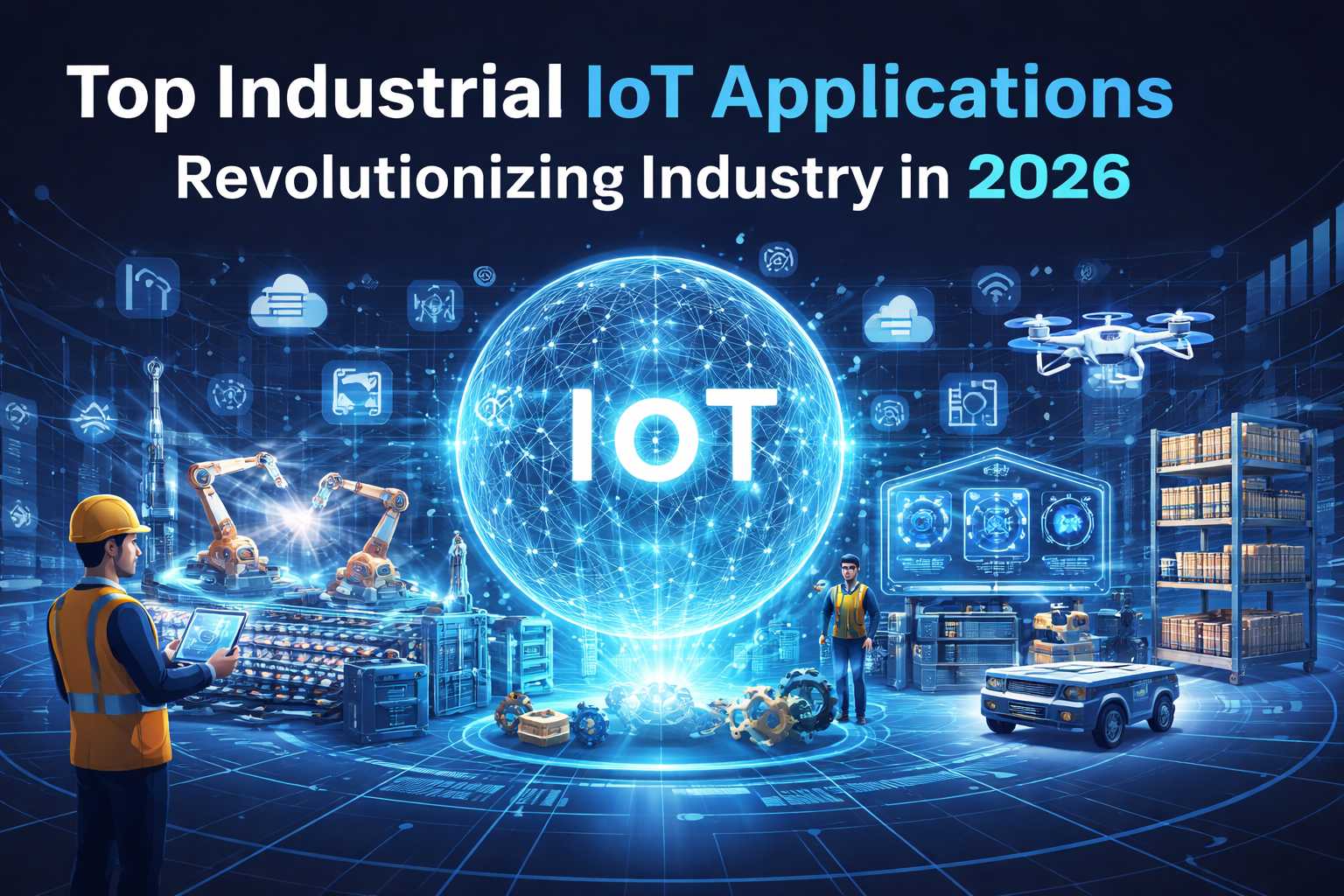
The industrial world is undergoing a massive digital transformation, and at the center of it is Industrial IoT. In 2026, factories, power plants, warehouses, and even farms are becoming intelligent environments where machines communicate, data flows in real time, and decisions are driven by insights rather than guesswork.
Industrial (IIoT) refers to the network of connected devices, sensors, machines, and software used in industrial settings to collect, analyze, and act on data. Unlike consumer IoT, which focuses on smart homes and wearables, IoT is built for heavy-duty environments where efficiency, safety, and reliability are critical.
Let’s dive into the most powerful Industrial IoT applications transforming industries in 2026.
1. Predictive Maintenance: Fix Problems Before They Happen
Traditional maintenance waits for a machine to fail or follows a fixed schedule. Both approaches are costly and inefficient. Industrial IoT changes this with predictive maintenance.
Smart sensors are attached to industrial equipment to monitor vibration, temperature, pressure, and noise levels. These sensors send continuous data to analytics platforms that detect unusual patterns. When early signs of wear or malfunction appear, maintenance teams receive alerts.
Impact in 2026:
- Consequently, unplanned downtime is significantly reduced
- Lower repair and spare part costs
- Longer equipment lifespan
- Safer working conditions
In fact, predictive maintenance powered by IoT is now widely recognized as a standard strategy in manufacturing, oil & gas, and power generation
2. Real-Time Production IOT Monitoring
In 2026, factory managers no longer rely on end-of-day reports. With Industrial IoT, they can see what’s happening on the production floor in real time.
Connected machines share live performance data such as output rate, cycle time, and error counts. Dashboards display this information in easy-to-understand visuals, helping teams spot bottlenecks immediately.
If one line slows down, supervisors can act instantly instead of discovering the issue hours later.
3. Smart Supply Chains with End-to-End Visibility
Supply chains have become more complex than ever, and Industrial IoT is making them more transparent and manageable.
Sensors and tracking devices are placed on goods, containers, and vehicles. These devices monitor location, temperature, humidity, and handling conditions. All this data is shared across the supply chain.
Key benefits include:
- Accurate shipment tracking
- Reduced loss and theft
- Better demand forecasting
- Faster response to delays
In industries like pharmaceuticals and food, IoT ensures products stay within safe environmental conditions during transport.
4. Energy Efficiency and Smart Utilities
As energy costs continue to rise, Industrial IoT empowers companies to monitor and fine-tune energy usage with greater precision.
Smart meters and connected sensors track how much electricity, gas, or water each machine or department consumes. For example, IoT can automatically power down idle machines or shift energy-intensive tasks to off-peak hours. iIn addition to reducing costs, this advances sustainability objectives.
5. Worker Safety and Smart Wearables
Industrial environments can be dangerous, but Industrial IoT is making workplaces safer through connected safety systems.
Wearable devices such as smart helmets, vests, and wristbands track workers’ location and physical condition. Sensors can detect falls, exposure to harmful gases, or extreme fatigue.
If a worker enters a restricted area or faces a health risk, supervisors receive instant alerts. Emergency teams can also locate workers quickly in case of accidents.
By 2026, Industrial IoT safety solutions are widely used in mining, construction, and heavy manufacturing.
6. Asset Performance Management
Large industrial companies manage thousands of assets across multiple sites. Industrial IoT enables centralized monitoring of all critical equipment.
Sensors collect performance data from turbines, compressors, pumps, and other machinery. This data is analyzed to evaluate efficiency, reliability, and wear.
Instead of treating all assets the same, companies can prioritize maintenance and upgrades based on real performance data. Industrial IoT helps maximize return on expensive equipment investments.
7. Quality Assurance Through Smart Inspection
Because maintaining consistent product quality is vital for brand reputation, Industrial IoT strengthens quality control through sensors, cameras, and intelligent software.
During production, connected inspection systems measure dimensions, surface finish, and structural integrity. Defects are detected instantly, and faulty items are removed before reaching customers.
This real-time quality monitoring reduces waste, prevents recalls, and ensures compliance with industry standards. Industrial IoT makes quality assurance proactive rather than reactive.
8. Remote Operations and Control Centers
As Industrial IoT continues to evolve, many industrial facilities in 2026 are now monitored and managed from centralized control rooms, improving efficiency and real-time decision-making.
Remote dashboards provide live data from machines and systems located hundreds or even thousands of kilometers away. Engineers can adjust settings, restart equipment, or troubleshoot issues without traveling to the site.
This is especially valuable in remote or hazardous locations such as offshore oil rigs, wind farms, and mining sites. Industrial IoT reduces operational costs while improving response time.
9. Digital Twins for Smarter Decision-Making
While a digital twin represents a physical asset or system virtually, Industrial IoT feeds it with real-time data to maintain accuracy
Companies use digital twins to simulate changes before applying them in the real world. For example, they can test how a new production process will affect output or how equipment will behave under higher loads.
As a result, this reduces risk and supports better planning. Consequently, Industrial IoT-powered digital twins are now widely adopted in advanced manufacturing and infrastructure projects.
10. Automation and Intelligent Robotics
Robots have been used in industry for decades, but Industrial IoT is making them smarter and more connected.
Modern industrial robots share data with other machines and central systems. They adjust their speed and tasks based on real-time production needs. If a problem occurs, they can stop automatically to prevent damage or injury.
Collaborative robots, or cobots, work alongside humans and rely on IoT systems to ensure safe interaction.
11. Environmental Monitoring and Sustainability
As environmental responsibility becomes a growing priority, Industrial IoT enables industries to minimize their impact
Sensors monitor emissions, waste output, and resource usage. If pollution levels exceed limits, systems send alerts immediately. Companies can also track water and raw material consumption to identify areas for improvement.
IoT supports sustainability reporting and helps businesses meet environmental regulations while building a greener image.
12. Smart Warehousing and Logistics
Warehouses in 2026 are far more automated due to Industrial IoT. Connected shelves, scanners, and robots work together to manage inventory.
When stock levels change, systems update automatically. Smart forklifts and automated guided vehicles move goods efficiently while avoiding collisions. Managers can see inventory levels in real time and make faster decisions.
IoT reduces human error and speeds up order fulfillment in large distribution centers.
Challenges That Industrial IoT Is Solving
Industries face constant pressure to reduce costs, improve efficiency, and stay competitive. Industrial IoT directly addresses these challenges by:
- Turning raw data into actionable insights
- Reducing manual monitoring
- Improving coordination between systems
- Enabling faster, smarter decisions
What once required guesswork is now supported by real-time data and advanced analytics.
The Road Ahead for Industrial IoT
As connectivity improves and technologies like edge computing and 5G expand, IoT systems are becoming faster and more reliable. Data processing at the edge allows quicker responses, while cloud platforms provide powerful analytics.
Cybersecurity is also improving, making Industrial IoT safer for mission-critical operations. In the coming years, we can expect even deeper integration between machines, software, and human operators.
Conclusion
In 2026, Industrial IoT is no longer optional — it is essential for industries that want to stay competitive. From predictive maintenance and smart factories to connected supply chains and worker safety, IoT is reshaping how the industrial world operates.
Organizations that invest in Industrial IoT today are building smarter, safer, and more efficient operations for the future. As adoption continues to grow, Industrial IoT will remain a driving force behind the next wave of industrial innovation.