The world around us is becoming smarter From intelligent water management systems and smart factories to connected healthcare devices and smart cities, nearly every sector is increasingly powered by connected technology. As a result, businesses and governments alike are relying more than ever on integrated, data-driven systems to improve efficiency, visibility, and decision-making. At the heart of this transformation lies one foundational concept: IoT Architecture. If you’ve ever wondered how a tiny sensor in a remote location sends data to a cloud dashboard in real time, this guide will walk you through the process step by step
In 2026, IoT Architecture is no longer just about connecting devices. Instead, it’s about building scalable, secure, and intelligent ecosystems that not only support advanced analytics and automation but also enable seamless IoT monitoring at scale.
What Is IoT Architecture?
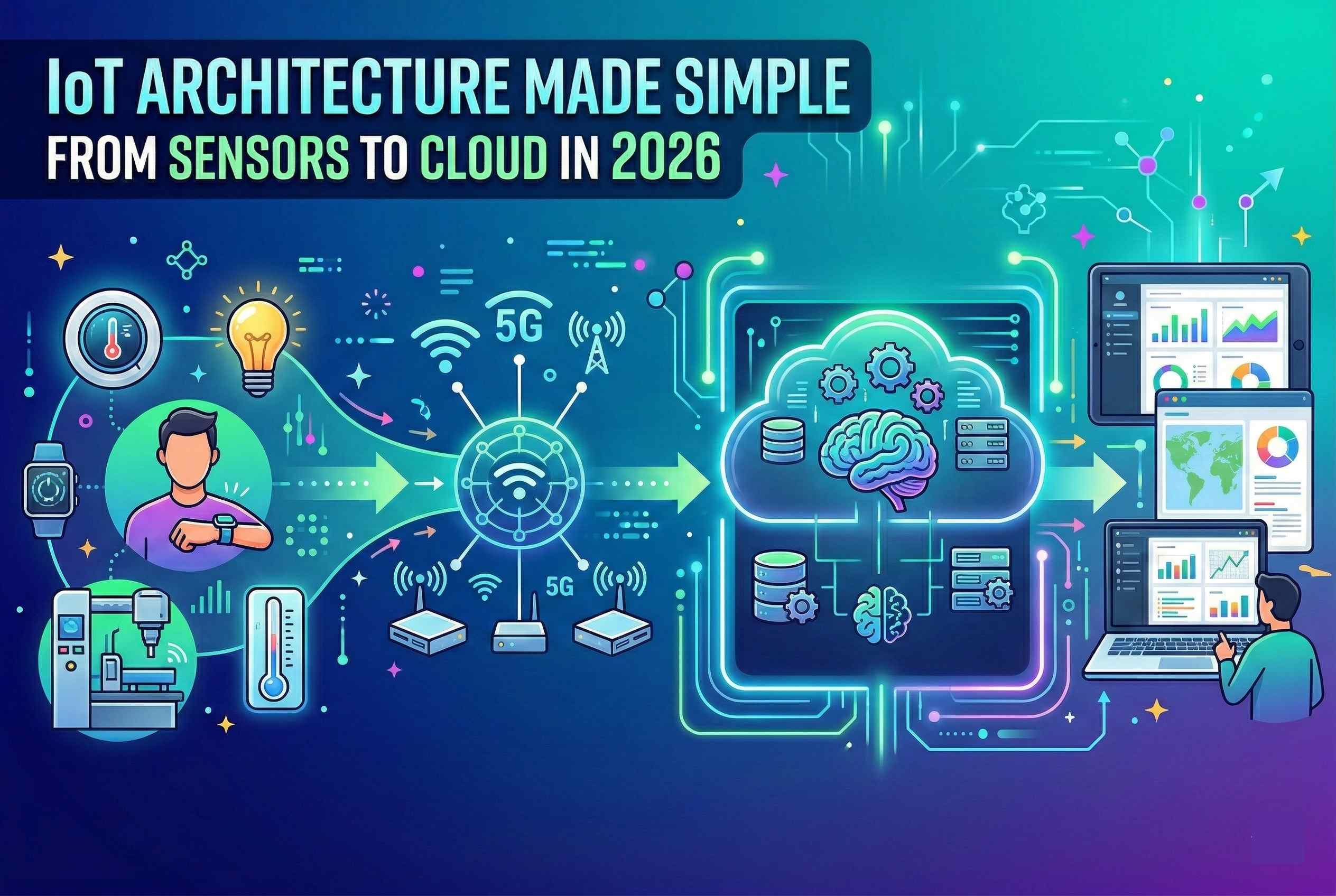
IoT Architecture refers to the structured framework that connects physical devices, such as sensors and actuators, to software systems in the cloud. In essence, it defines how data flows from initial collection to processing, storage, analysis, and ultimately, visualization.
Think of it as a digital highway system:
- Sensors collect raw data.
- Connectivity layers transport that data.
- Processing systems analyze it.
- Applications turn insights into action.
A well-designed IoT Architecture ensures smooth communication between all these components while maintaining performance, reliability, and security.
The Core Layers of IoT Architecture in 2026
Modern IoT Architecture typically consists of four major layers. First and foremost, each layer has a specific role. When combined, however, they work together seamlessly to create a complete and fully integrated ecosystem.
1. Device Layer (Sensors & Actuators)
This is where everything begins.
Devices include:
- Temperature sensors
- Pressure sensors
- Flow meters
- GPS modules
- Smart meters
- Industrial controllers
These devices collect environmental or operational data. For example:
- A water flow sensor measures pipeline pressure to monitor performance and detect potential issues.
- A temperature sensor monitors cold storage.
- A vibration sensor tracks machinery health.
In advanced IoT monitoring systems, devices are now smarter than ever. Many come with embedded microcontrollers capable of basic data filtering before transmission.
In 2026, edge intelligence is increasingly common. Instead of sending every bit of raw data to the cloud, devices can preprocess information locally, reducing bandwidth usage and latency.
2. Connectivity Layer
Once data is collected, it needs to travel. The connectivity layer ensures reliable data transmission from devices to centralized systems.
Common communication technologies include:
- Wi-Fi
- Bluetooth Low Energy (BLE)
- LoRaWAN
- NB-IoT
- 4G/5G
- Ethernet
The choice depends on:
- Range requirements
- Power availability
- Data volume
- Deployment environment
For industrial IoT monitoring, long-range low-power protocols like LoRaWAN and NB-IoT are widely used. In high-speed environments like manufacturing, Ethernet and 5G dominate.
Connectivity is no longer just about sending data; rather, it’s about sending it securely. Therefore, modern IoT Architecture includes encrypted communication channels and robust device authentication at this layer to ensure data integrity and protection.
3. Edge Layer (Local Processing)
The edge layer sits between devices and the cloud. It includes gateways and edge servers that perform:
- Data filtering
- Protocol translation
- Local analytics
- Temporary storage
Why is edge computing important in 2026?
Because not all decisions can wait for cloud processing.
For example:
- A machine overheating requires immediate shutdown.
- A pressure spike in a pipeline needs instant alerts.
In such cases, edge systems process data in milliseconds and trigger local actions without relying on cloud latency.
Edge computing significantly enhances IoT monitoring by enabling real-time response while reducing cloud workload.
4. Cloud Layer
The cloud is where large-scale intelligence happens.
Cloud platforms handle:
- Data storage
- Advanced analytics
- Machine learning models
- Dashboard visualization
- API integrations
Cloud infrastructure provides scalability. Whether you have 100 devices or 1 million devices, a properly designed IoT Architecture can handle growth seamlessly.
In 2026, cloud-native IoT platforms support:
- Serverless computing
- Containerized applications
- AI-powered predictive analytics
- Digital twins
Cloud-based IoT monitoring dashboards allow businesses to track performance metrics in real time, generate automated reports, and trigger alerts based on predefined thresholds.
Data Flow in IoT Architecture: A Simple Example
Let’s understand the complete flow with a practical scenario.
Imagine a smart water pipeline monitoring system.
- A pressure sensor measures pipeline pressure every 10 seconds.
- The sensor sends data to a nearby IoT gateway.
- The gateway filters abnormal readings.
- Data is transmitted via cellular connectivity to the cloud.
- The cloud platform stores and analyzes the data.
- A dashboard displays real-time metrics.
- If pressure crosses a limit, an automated alert is sent.
This entire sequence defines a well-structured IoT Architecture.
Each layer works independently yet cohesively.
Security in IoT Architecture
Security is no longer optional; in 2026, IoT security has become a critical component of architectural design.
Key security elements include:
- Device authentication
- End-to-end encryption
- Secure boot mechanisms
- Firmware updates over the air (FOTA)
- Role-based access control
IoT monitoring systems often handle sensitive infrastructure data; therefore, a vulnerability in even one device can potentially compromise the entire network.
That’s why modern IoT Architecture follows a “security-by-design” approach rather than adding protection later.
Scalability and Flexibility
A common mistake in early IoT deployments was building rigid systems.
In 2026, scalable IoT Architecture must support:
- Device expansion
- Geographic growth
- Software updates
- Integration with third-party platforms
Modular architecture ensures that new sensors or analytics tools can be integrated seamlessly without disrupting the existing system.
Cloud-native designs and microservices play a key role here.
Role of AI and Analytics in IoT Architecture
Raw data alone has limited value.
Modern IoT monitoring relies on:
- Predictive maintenance models
- Anomaly detection
- Trend forecasting
- Energy optimization algorithms
AI-powered analytics transform IoT Architecture from a passive monitoring system into an intelligent decision-making engine.
For example:
- Predicting equipment failure before breakdown.
- Identifying leakage patterns in water systems.
- Optimizing energy usage in smart buildings.
The integration of AI directly into cloud and edge layers is defining next-generation IoT ecosystems.
IoT Architecture for Different Industries
Different industries implement IoT Architecture differently, but the foundational structure remains similar.
Smart Manufacturing
- Machine health monitoring
- Predictive maintenance
- Production optimization
Smart Cities
- Traffic monitoring
- Waste management
- Environmental sensing
Healthcare
- Remote patient monitoring
- Wearable device tracking
- Asset management
Water and Utility Management
- Flow monitoring
- Leak detection
- Pressure management
Across all these sectors, IoT monitoring ensures greater data visibility, improved operational efficiency, and significantly reduced downtime.
Common Challenges in IoT Architecture
Despite advancements, challenges remain:
- Device interoperability
- Data overload
- Cybersecurity threats
- Network instability
- Power management
Solving these requires strategic planning at the architecture level rather than patchwork solutions later.
Best Practices for Designing IoT Architecture in 2026
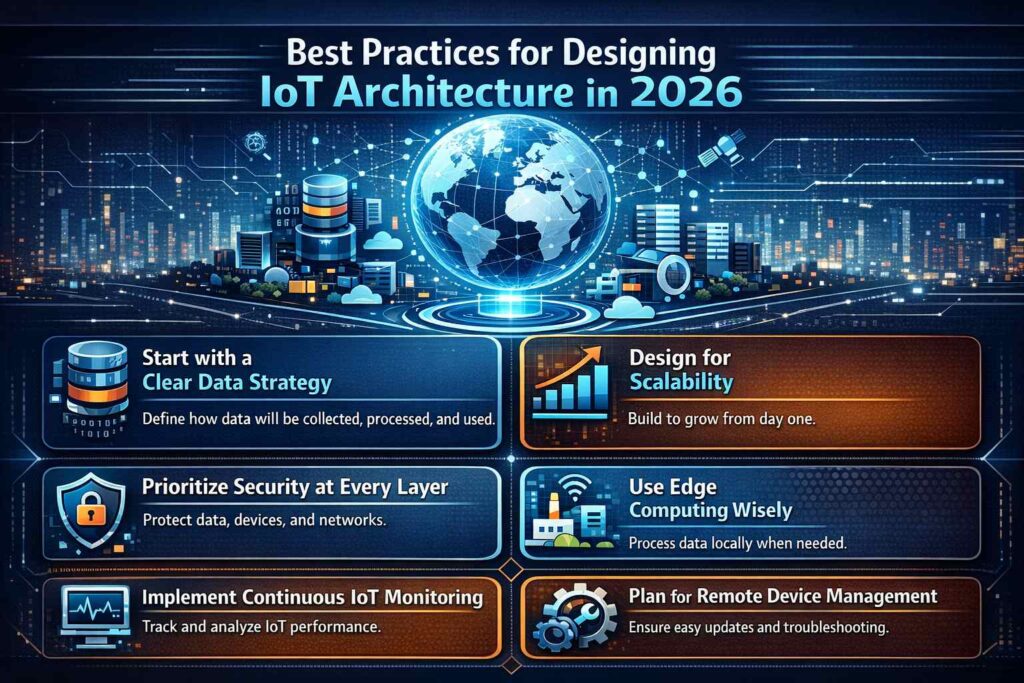
To build a future-ready IoT system:
- Start with a clear data strategy.
- Design for scalability from day one.
- Prioritize security at every layer.
- Use edge computing wisely.
- Implement continuous IoT monitoring.
- Plan for remote device management.
Architecture is not just technical it’s strategic.
Why IoT Monitoring Is the Backbone of Modern Operations
IoT monitoring goes beyond dashboards. It enables:
- Real-time operational visibility
- Reduced downtime
- Faster decision-making
- Automated alerts
- Data-driven optimization
Organizations that treat IoT monitoring as a core capability rather than an add-on gain a significant competitive advantage.
In 2026, businesses are no longer asking whether to adopt IoT; instead, they’re asking how to optimize their IoT Architecture for maximum performance.
The Future of IoT Architecture
Looking ahead, IoT Architecture will continue evolving with:
- 5G expansion
- AI at the edge
- Digital twin ecosystems
- Blockchain-based device identity
- Sustainable low-power devices
Going forward, the focus will gradually shift from merely connecting devices to building intelligent, autonomous systems capable of continuous learning and self-optimization.
Interoperability standards are improving, making cross-platform integrations smoother than ever.
Final Thoughts
IoT Architecture is the foundation of every connected system in today’s digital world. From sensors collecting raw data to cloud platforms generating actionable insights, each layer plays a critical role in delivering seamless IoT monitoring. In 2026, simplicity in architecture does not mean reduced capability it means well-structured, secure, and scalable design. When properly implemented, IoT Architecture empowers organizations to move from reactive operations to predictive and automated ecosystems.
Whether you’re building a smart factory, managing utilities, or developing industrial monitoring systems, understanding IoT Architecture is the first step toward building reliable, future-ready solutions.