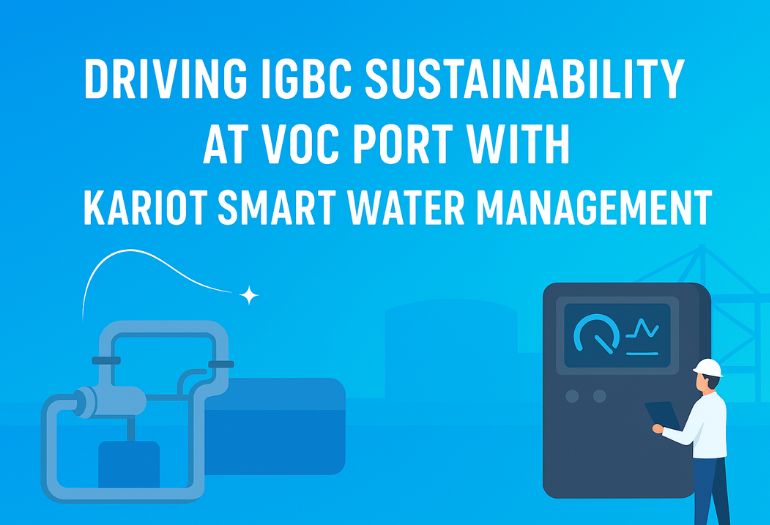
Sustainability is no longer just a goal; it has become a critical operational requirement for large industrial and infrastructure facilities. Ports, in particular, face significant challenges when it comes to water management, given their complex operational environments and high-demand infrastructure. Recognizing this, V. O. Chidambaranar Port Authority (VOC Port) has partnered with Kariot to deploy its Smart Water Management Solution, a cutting-edge platform leveraging industrial IoT to improve operational efficiency, water conservation, and sustainability compliance.
This deployment is especially significant because ports are traditionally water-intensive environments where even minor inefficiencies can have a major environmental and operational impact. By using smart water management using IoT, VOC Port has achieved real-time control over its water systems while aligning with IGBC water credit requirements, setting a benchmark for other industrial facilities across India.
Why Smart Water Management Matters in Ports
Ports manage vast water networks across operational zones, including cooling systems, cleaning operations, landscaping, and firefighting infrastructure. Traditional water monitoring methods often involve manual checks, delayed meter readings, and reactive maintenance. Such approaches are prone to inefficiencies, leaks, and higher operational costs.
By adopting IoT remote monitoring solutions, VOC Port now gains real-time insights into water usage, helping the port manage resources proactively and reduce wastage. This transition marks a shift from conventional water management practices to a data-driven, intelligent system.
Importance of Smart Water Management at Ports
Ports are hubs of industrial activity, handling everything from cargo operations to maintenance and facility management. This requires large-scale water use across multiple areas, including:
- Operational use for machinery, cooling systems, and cleaning
- Fire safety systems that rely on high water availability
- Landscaping and facility maintenance for operational and aesthetic purposes
- Utility and administrative facilities spread across the port
Traditional water management methods, which rely on manual meter readings, periodic checks, and reactive maintenance, are insufficient in these complex environments. They often result in delayed responses to leaks, overflows, and pump failures, contributing to water wastage and operational inefficiencies.
With IoT-powered remote monitoring systems in place, VOC Port can now track water consumption in real time across every facility, quickly spot irregularities, and take preventive action before problems escalate. This shift marks a significant move toward smarter, data-driven water management setting a new benchmark for ports and industrial environments.
Water Management Challenges in Port Operations
Ports operate as bustling industrial hubs with diverse water requirements:
- Operational processes: Machinery cooling, cleaning, and maintenance demand consistent water supply.
- Fire safety: Ready access to water is vital for emergency preparedness.
- Landscaping and facility upkeep: Aesthetic and functional maintenance of port grounds.
- Administrative and utility facilities: Spread across vast areas requiring monitored water supply.
Features and Capabilities of Kariot’s Solution
Kariot’s deployment integrates advanced IoT devices, robust communication networks, and intelligent analytics. The solution’s capabilities are tailored to meet the rigorous demands of industrial-scale port operations:
1. Continuous Real-Time Monitoring
A smart water management system allows VOC Port to track water inflow, outflow, and consumption patterns in real time. Facility managers can detect irregular usage trends, prevent leaks, and optimize distribution across operational zones. This ensures efficient water use while minimizing wastage.
2. Automated Alerts for Rapid Response
Ports experience unexpected challenges such as pump failures, overflows, or abnormal water consumption. Kariot provides instant notifications to maintenance teams, ensuring timely corrective action and uninterrupted operations.
3. Streamlined Reporting for IGBC Compliance
IGBC water credit certification requires detailed documentation of water usage and conservation efforts. Kariot automates this reporting process, generating accurate, compliance-ready reports and reducing manual workload.
4. Data Analytics for Informed Planning
The platform’s analytics engine offers insights into water and energy consumption, allowing VOC Port to plan operational schedules, forecast demand, and implement long-term conservation strategies efficiently.
5. LoRaWAN Wireless Connectivity
Covering a port’s extensive area requires reliable communication. Using IoT gateways with LoRaWAN technology, Kariot ensures uninterrupted data transmission from smart water meters and other devices, even in challenging industrial conditions.
6. IoT Device Management and Smart Water Meters
With integrated smart water meters and IoT device management, VOC Port can monitor device status, perform remote diagnostics, and maintain high operational efficiency with minimal manual intervention. This integration ensures transparency, accountability, and optimized resource utilization.
Overcoming Challenges in Port Environments
Introducing IoT technology into a busy port ecosystem isn’t simple. The environment is tough high moisture levels, dust-filled zones, continuous vibration from large equipment, and extreme weather can all disrupt device performance. Kariot tackled these real-world challenges by:
- Selecting rugged industrial IoT devices capable of operating in harsh conditions
- Strategically placing IoT gateways to cover large operational zones
- Calibrating sensors to provide accurate readings aligned with IGBC water credit requirements
- Ensuring seamless integration with the port’s existing water infrastructure
This attention to detail ensures reliable performance, even in complex industrial environments, and allows VOC Port to maintain industrial automation in IoT without manual dependency.
Addressing Environmental and Operational Challenges
Implementing IoT solutions within a port setting comes with serious environmental hurdles from moisture-heavy air and dust exposure to constant vibrations and the movement of heavy equipment. Kariot successfully navigated these challenges by:
- Deploying industrial IoT devices designed for rugged environments.
- Strategically positioning IoT gateways to ensure full coverage.
- Calibrating sensors for accuracy and alignment with IGBC standards.
- Seamlessly integrating devices into the existing water infrastructure for continuous operations.
These measures allow VOC Port to maintain industrial automation in IoT without disruptions, ensuring reliability and resilience in operations.
Driving Sustainability with Smart Water Management
The integration of IoT technologies enables VOC Port to achieve meaningful water conservation while maintaining operational efficiency. Smart water management solutions not only reduce waste but also provide actionable insights for sustainability reporting and resource optimization.
By deploying IoT monitoring, the port can proactively address maintenance issues, minimize downtime, and ensure compliance with IGBC standards. The system also empowers management teams to implement industrial automation practices, which further improve efficiency and reduce environmental impact.
Benefits of Kariot’s Deployment at VOC Port
The deployment illustrates the tangible benefits of combining IoT with smart water management:
- Operational Efficiency: Automated monitoring and alerts reduce manual checks and prevent system failures.
- Water Conservation: Smart meters track usage, enabling proactive water-saving measures.
- Sustainability Compliance: IGBC-aligned reporting simplifies certification processes.
- Data-Driven Decisions: Analytics help plan future water and energy use efficiently.
- Scalable Solution: Wireless IoT gateways support expansion across large operational areas.
- Enhanced Accountability: Transparent data reporting encourages responsible water use.
Real-World Impact of Smart Water Management
The deployment highlights the real-world impact of integrating IoT monitoring with water management systems:
- Immediate issue detection: Leaks, overflows, and pump failures are identified before escalating.
- Operational reliability: Minimizing water interruptions ensures port operations run smoothly.
- Sustainability leadership: VOC Port demonstrates a commitment to IGBC goals and environmental responsibility.
- Long-term efficiency: Historical data supports planning for water use, maintenance, and resource optimization.
These improvements demonstrate that smart water management using IoT is not just a technical upgrade but a strategic approach to sustainable port operations.
Kariot’s Vision for Smarter, Greener Infrastructure
The VOC Port project exemplifies Kariot’s commitment to smart water management and sustainable infrastructure across India. By integrating industrial IoT solutions into water management systems, organizations can reduce wastage, optimize resource allocation, and enhance operational efficiency.
Kariot’s approach demonstrates that smart water management using IoT is not just a technological upgrade, it is an operational necessity for modern infrastructure. Through IoT device monitoring, ports and industrial facilities can align operational goals with environmental responsibility.
Collaborative Effort for a Successful Implementation
The success of this deployment was made possible by collaboration between VOC Port Authority and Kariot’s engineering team. Every step from site survey and planning to calibration, installation, and configuration was executed with precision. This ensured that the system met both operational needs and IGBC-aligned sustainability targets.
By leveraging IoT industrial automation and smart water meters, the team achieved a seamless integration, setting a benchmark for future projects in port management and industrial water conservation.
Looking Ahead: The Future of Smart Water Management in Industrial IoT
The VOC Port project sets a precedent for large-scale industrial water management. As organizations increasingly adopt industrial IoT solutions, the benefits are clear:
- Improved resource efficiency and cost savings
- Compliance with sustainability and regulatory requirements
- Reduced environmental footprint through smarter water management
- Scalable solutions for expanding industrial operations
Kariot continues to innovate in the field of IoT remote monitoring solutions, enabling ports, factories, and large-scale facilities to achieve smarter, data-driven, and sustainable operations.

Conclusion
The deployment of Kariot Smart Water Management at VOC Port is a milestone in sustainable industrial operations. By integrating IoT-enabled monitoring solutions, the port has achieved real-time visibility, automated compliance reporting, and actionable insights for water conservation. This initiative underscores the potential of smart water management using IoT in industrial ecosystems, demonstrating how technology can enhance operational efficiency while supporting environmental goals.
Through this project, VOC Port is now a benchmark for smart water management, inspiring other ports and industrial facilities to adopt similar solutions. Kariot remains committed to empowering organizations with industrial IoT solutions, driving a future that is smarter, greener, and more efficient.