Today, many businesses use connected devices to collect and share data. Industries like manufacturing, healthcare, transportation, utilities, and smart cities depend on these devices to improve their daily operations. An Edge Gateway plays an important role by processing data close to the devices instead of sending everything to the cloud. This helps businesses make faster decisions, reduce network traffic, improve security, and keep their systems running smoothly.
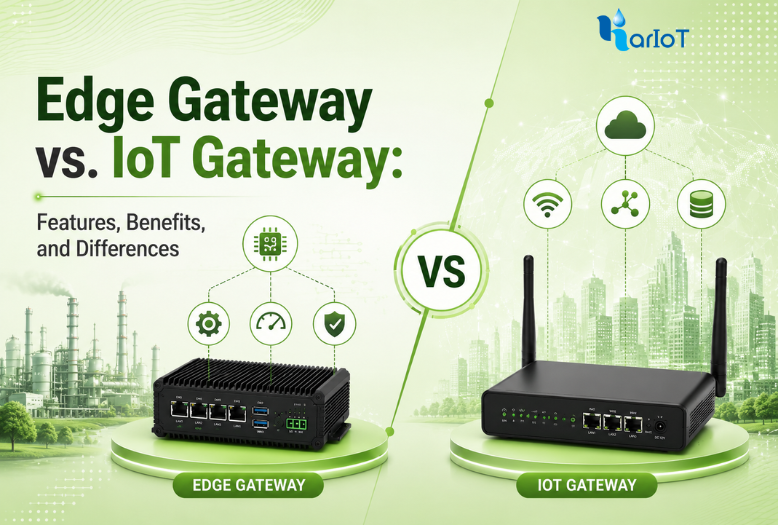
Many people think an Edge Gateway and an IoT Gateway are the same, but they have different roles. An IoT Gateway mainly connects devices and sends data to the cloud, while an Edge Gateway can also process and analyze data before sending only the important information. Knowing the difference between these two technologies can help you choose the right solution for your business. In this blog, we’ll explain their features, benefits, key differences, and common use cases in simple terms so you can easily understand which one best fits your needs.
What Is an Edge Gateway?
An Edge Gateway is a hardware or software device that connects field devices, sensors, controllers, and machines to enterprise applications or cloud platforms while processing data close to where it is generated. Instead of sending every piece of information to a remote server, it performs computing tasks locally, reducing network traffic and improving response times.
This local processing is especially valuable for industries where real-time decisions are critical. Manufacturing plants, energy facilities, transportation systems, and utilities often depend on edge computing to minimize latency and improve operational reliability.
An Edge Gateway typically performs the following functions:
- Collects data from connected devices
- Filters and processes information locally
- Runs analytics at the edge
- Translates industrial communication protocols
- Secures data before transmission
- Sends only relevant information to the cloud
Because processing occurs closer to the data source, organizations experience faster performance and reduced bandwidth usage.
What Is an IoT Gateway?
An iot gateway primarily acts as a communication bridge between IoT devices and cloud applications. Its primary role is to collect data from connected devices, convert different communication protocols, and securely transmit information to centralized platforms.
Unlike an Edge Gateway, an IoT Gateway focuses mainly on connectivity rather than advanced local processing. Most of the analytics, storage, and decision-making take place within cloud infrastructure after the data has been transmitted.
In general, IoT Gateways are widely deployed in environments where continuous cloud connectivity is available and local computing requirements are minimal.
Why Do Businesses Need Gateway Solutions?
Modern organizations generate enormous amounts of operational data every second. Consequently, processing all this information in the cloud can introduce delays, increase bandwidth costs, and create dependency on internet connectivity.
Gateway technologies solve these challenges by acting as intelligent intermediaries between devices and enterprise systems.
Some common business challenges include:
- Large volumes of sensor data
- Different industrial communication protocols
- Security concerns
- Network limitations
- Remote equipment management
- Real-time operational requirements
Selecting the appropriate gateway helps organizations improve efficiency while maintaining secure and reliable communication.
Key Features of an Edge Gateway
An Edge Gateway offers several advanced capabilities that make it suitable for demanding industrial environments.
1. Local Data Processing
One of the biggest advantages is processing information at the source rather than relying entirely on cloud servers.
This enables businesses to:
- Respond instantly to equipment conditions
- Reduce unnecessary data transfers
- Improve application performance
- Lower cloud storage costs
2. Protocol Conversion
Industrial facilities often use equipment from multiple manufacturers that communicate using different protocols.
An Edge Gateway can translate between protocols such as:
- Modbus
- OPC UA
- CAN Bus
- MQTT
- BACnet
- Ethernet/IP
This interoperability allows legacy equipment and modern devices to work together seamlessly.
3. Enhanced Security
Security remains one of the biggest concerns in connected environments.
Modern Edge Gateways provide multiple security layers, including:
- Device authentication
- Secure boot
- Data encryption
- Firewall protection
- VPN connectivity
- Role-based access control
These features help organizations reduce cybersecurity risks while protecting operational data.
4. Intelligent Analytics
Unlike traditional gateways, Edge Gateways can perform analytics locally.
Instead of sending every sensor reading to the cloud, they identify meaningful events before transmission.
Examples include:
- Machine fault detection
- Predictive maintenance alerts
- Quality inspection
- Production monitoring
- Energy optimization
This significantly reduces bandwidth consumption while improving response times.
5. Scalability
As organizations expand, they add more devices and production lines.
Edge Gateways support scalable deployments by managing thousands of connected devices without sacrificing performance.
This flexibility makes them ideal for growing enterprises.
Features of an IoT Gateway
Although IoT Gateways focus more on communication than computing, they remain an essential part of connected ecosystems.
Their primary features include:
Device Connectivity
They connect sensors, controllers, and field devices using multiple communication technologies.
These include:
- Wi-Fi
- Ethernet
- Cellular
- Bluetooth
- Zigbee
- LoRaWAN
Secure Data Transmission
An IoT Gateway ensures information reaches cloud platforms securely through encrypted communication channels.
Cloud Integration
Most IoT Gateways are designed for seamless integration with cloud services, enabling centralized monitoring, storage, and reporting.
This becomes particularly useful for businesses adopting IoT cloud computing, where scalable infrastructure supports analytics and long-term data management.
Remote Configuration
Administrators can remotely configure connected devices, update firmware, and troubleshoot issues without visiting each installation site.
Many organizations combine this capability with iot device management to simplify operations across geographically distributed deployments.
Benefits of Using an Edge Gateway
Organizations across multiple industries are increasingly investing in Edge Gateway technology because it delivers measurable operational improvements.
Faster Decision-Making
Since information is processed locally, systems respond almost instantly to operational changes.
For example, a manufacturing robot can stop immediately when a fault occurs instead of waiting for cloud-based instructions.
Lower Bandwidth Costs
Only important data is transmitted to cloud platforms.
This significantly reduces internet usage while lowering operational expenses.
Improved Reliability
Even if internet connectivity becomes unavailable, the Edge Gateway continues processing critical operations locally.
This ensures business continuity during network interruptions.
Better Data Privacy
Sensitive operational information remains within the local environment rather than constantly traveling across external networks.
For industries handling confidential production data, this provides an additional layer of protection.
Support for Industrial Applications
Edge computing has become increasingly important in industrial iot, where production environments demand continuous monitoring, low latency, and reliable performance.
Manufacturers, logistics providers, and energy companies use Edge Gateways to maintain operational efficiency while minimizing downtime.
Common Use Cases
Edge Gateway technology supports numerous real-world applications across industries.
Some popular examples include:
Smart Manufacturing
Factories monitor machines, automate workflows, and detect failures before they cause production delays.
Water Utilities
Municipal authorities increasingly deploy smart water management system solutions to monitor pipelines, detect leaks, and improve resource utilization.
Infrastructure Monitoring
Organizations use Edge Gateways alongside iot sensors to collect operational data from bridges, tunnels, substations, and transportation networks.
Because processing happens locally, alerts are generated much faster than traditional cloud-only architectures.
In the next section, we’ll compare Edge Gateway and IoT Gateway side by side, explore their architecture, advantages, limitations, ideal use cases, and help you determine which solution best fits your business requirements.
Edge Gateway vs. IoT Gateway: Understanding the Differences
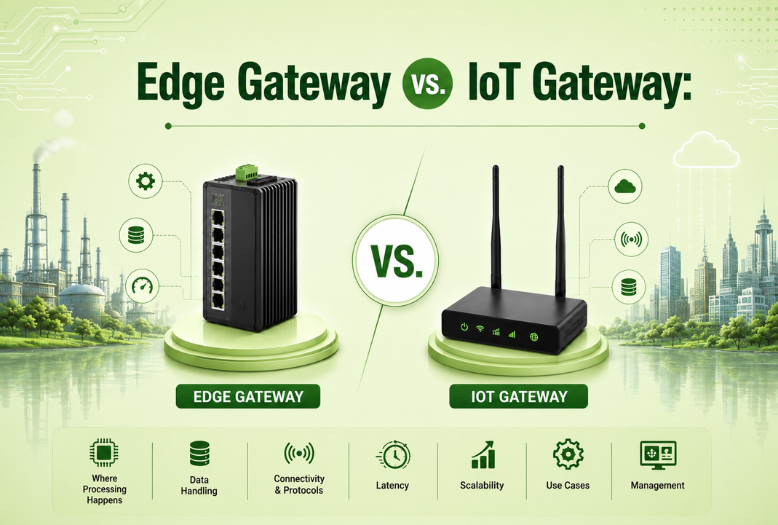
Although both gateway technologies connect devices and facilitate communication, they differ significantly in how they process data, manage workloads, and support industrial applications. Understanding these distinctions helps businesses invest in the right solution for their operational goals.
| Feature | Edge Gateway | IoT Gateway |
| Data Processing | Processes data locally | Sends most data to the cloud |
| Latency | Very low | Moderate |
| Bandwidth Usage | Reduced | Higher |
| Decision-Making | Local and real-time | Cloud-based |
| Internet Dependency | Can operate during outages | Requires stable connectivity |
| Security | Local security controls and encryption | Cloud-focused security |
| Analytics | Runs analytics at the edge | Cloud analytics |
| Best For | Manufacturing, utilities, transportation | Smart homes, connected buildings, basic IoT deployments |
Overall, organizations that require rapid responses, continuous operations, and reduced network traffic benefit more from edge computing, while businesses with simpler connectivity needs often find an IoT Gateway sufficient.
How Does an Edge Gateway Differ from an IoT Gateway?
An IoT Gateway focuses on collecting information from devices and forwarding it to cloud applications. In contrast, an Edge Gateway processes information locally before deciding what data should be transmitted. As a result, only meaningful insights, alerts, or summarized data reach the cloud.
For example, imagine a production line generating thousands of sensor readings every minute. An IoT Gateway forwards all the collected data to the cloud for analysis. An Edge Gateway, however, analyzes the information on-site, detects abnormal conditions instantly, and sends only critical events to the cloud. Consequently, businesses reduce bandwidth costs while improving operational efficiency.
Advantages of Choosing an Edge Gateway
As industries continue adopting digital transformation strategies, consequently, Edge Gateway solutions offer several advantages beyond traditional connectivity.
Reduced Network Congestion
Processing data locally significantly decreases the amount of information transmitted across enterprise networks. Therefore, organizations experience lower communication costs and better overall system performance.
Real-Time Operational Visibility
Manufacturers increasingly rely on iot device monitoring to track equipment health and detect anomalies. Consequently, by processing this information locally, maintenance teams receive alerts immediately, enabling them to prevent unexpected downtime.
Better Support for Remote Assets
Many businesses operate equipment in remote locations where internet connectivity is unreliable. An Edge Gateway continues processing operational data even during temporary communication failures, synchronizing information with the cloud once connectivity is restored.
Future-Ready Architecture
Consequently, as organizations deploy artificial intelligence, machine learning, and predictive maintenance solutions, local computing capabilities become increasingly important. Edge Gateways provide the processing power needed to support these advanced technologies without overwhelming cloud infrastructure.
When Is an IoT Gateway the Better Choice?
Despite the advantages of edge computing, an IoT Gateway remains an excellent option for many organizations.
It is particularly suitable when:
- Cloud connectivity is consistently available.
- Devices generate relatively small amounts of data.
- Real-time processing is not essential.
- Centralized cloud analytics meet business requirements.
- Initial deployment costs must remain low.
Small commercial buildings, retail stores, and office environments often benefit from this simpler architecture.
Industry Applications
Both technologies support numerous industries. However, their roles differ depending on operational requirements.
Manufacturing
Modern factories increasingly depend on iot industrial automation to optimize production lines, improve quality control, and reduce equipment failures. Local processing enables immediate responses whenever operational anomalies occur.
Water Management
Water utilities face growing pressure to reduce waste while improving infrastructure efficiency. Organizations implementing smart water management using iot can detect leaks, monitor consumption, and optimize distribution networks through intelligent gateway technologies.
Similarly, smart water meters provide accurate usage data that supports billing accuracy, conservation efforts, and resource planning.
Remote Infrastructure
Oil pipelines, renewable energy installations, and utility substations often require continuous iot remote monitoring solution deployments. Local analytics ensure critical alerts are generated immediately, even when communication with cloud servers is temporarily unavailable.
Industrial Operations
Consequently, factories embracing industrial automation gain greater visibility into equipment performance, production efficiency, and maintenance schedules. These capabilities contribute to safer operations and more consistent output.
Flow Measurement Systems
Facilities responsible for water distribution, chemicals, and energy frequently integrate a digital flow meter with gateway technologies to collect accurate measurement data. Local processing enables immediate detection of abnormal flow conditions before they affect operations.
How to Choose the Right Gateway
Choosing between an Edge Gateway and an IoT Gateway depends on several important factors.
Ask the following questions before making your decision:
- Do your operations require real-time decision-making?
- Is internet connectivity always available?
- How much data do your devices generate?
- Are cybersecurity requirements particularly strict?
- Will your deployment continue expanding over the coming years?
- Do you need local analytics or only cloud-based reporting?
If your organization depends on continuous availability, rapid processing, and advanced analytics, an Edge Gateway is generally the better investment. On the other hand, if your primary objective is secure cloud connectivity for smaller deployments, an IoT Gateway may adequately meet your needs.
Future Trends in Edge Gateway
- The future of connected technologies points toward greater intelligence at the network edge.
- Organizations are increasingly integrating gateway platforms with artificial intelligence, predictive analytics, and iot monitoring capabilities
- Meanwhile, businesses continue expanding Iot Applications across manufacturing, transportation, agriculture, healthcare, and energy sectors.
- Furthermore, companies investing in smart water solutions are combining intelligent gateways with cloud analytics to improve sustainability, reduce operational costs, and deliver more reliable public services.
- As digital transformation accelerates, edge computing will continue playing a central role in building scalable, secure, and resilient industrial ecosystems.
Conclusion
Both Edge Gateways and IoT Gateways are essential components of modern connected infrastructures, but they address different operational needs. An IoT Gateway primarily enables communication between connected devices and cloud platforms, making it well suited for applications that rely on centralized processing.In contrast, an Edge Gateway extends those capabilities by processing data locally, reducing latency, minimizing bandwidth usage, and enabling faster decision-making. These advantages make it an ideal solution for industries where real-time performance, operational continuity, and security are critical.
Before selecting a gateway solution, organizations should carefully evaluate their connectivity requirements, data volumes, processing needs, and long-term scalability goals. By choosing the right architecture today, businesses can build a strong foundation for future innovation while improving efficiency and resilience.
FAQs
1. What is the difference between an Edge Gateway and an IoT Gateway?
An Edge Gateway processes data locally before sending relevant information to the cloud, whereas an IoT Gateway primarily transfers data from connected devices to cloud platforms for centralized processing.
2. Why is an Edge Gateway important in industrial environments?
Therefore, it reduces latency while supporting real-time decision-making, improving operational reliability, lowering bandwidth usage, and enhancing security by processing sensitive data closer to connected devices.
3. Which industries benefit the most from Edge Gateway technology?
Manufacturing, utilities, transportation, energy, healthcare, logistics, agriculture, and smart city projects commonly use Edge Gateway technology because these industries require fast, reliable, and secure data processing.
4. Can an Edge Gateway work without an internet connection?
Yes. One of its major advantages is that it can continue processing and storing data locally during network interruptions. Once connectivity returns, it synchronizes the required information with cloud platforms.
5. How do I choose between an Edge Gateway and an IoT Gateway?
Ultimately, an Edge Gateway is ideal for local processing, real-time analytics, and uninterrupted operations. In contrast, an IoT Gateway is better suited for secure device connectivity and cloud-based data management with minimal local processing.