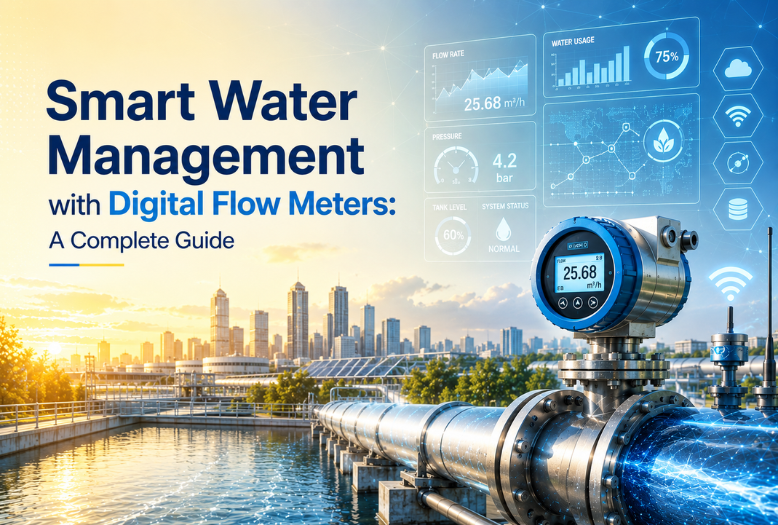
Water management has become essential for industries, cities, and infrastructure developers. As the demand for water management systems increases, the need for precision and sustainable systems increases. Digital Flow Meters provide the ability to assess water flow and display data in real time. Digital Flow Meters enable the water management system to be more efficient, minimize waste, and enhance control in management systems.
The transformation of water management systems has increased the level of control and efficiency with the introduction of technology and automation. Digital Flow Meters have played an important role in the transformation of water management systems. Digital Flow Meters have provided the control and management of water flow, allowing for the optimization of the system. The purpose of this guide is to familiarize the reader with the growing intelligence of water management systems and how digital flow meter technology will drive the future of water management systems.
Digital Transformation in Water Management
Water management systems have a multitude of issues, including but not limited to leakage, measurement discrepancies, unauthorized consumption, and inadequate control.
The bulk of the older systems rely on manual measurements. Of course, these are often delivered post factum, and often include some degree of measurable error.
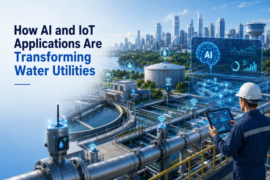
In order to improve upon these systems, a number of advanced technologies have come to the forefront. Perhaps the largest disruption has been in the smart water management arena. IoT (Internet of Things) technology has enabled real time tracking and automated control.
The Digital Flow Meter is perhaps the largest single player in this arena. It allows for the measurement and monitoring of water flow in a real-time, persistent manner. Without this sort of data, it is impossible to manage water optimally and detect inefficiencies.
Digital Flow Meters remove the guesswork, delivering real-time readings which empower better control over management and enhanced levels of transparency.
What is a Digital Flow Meter?
High-tech devices, known as Digital Flow Meters, measure the flow rate of liquids in pipelines with great accuracy. They measure flow in real time, unlike traditional mechanical meters, which display flow rates using physical movement.
As a result of their reliable capacity to deliver flow readings on the spot, Digital Flow Meters have become popular with industries, municipalities, smart buildings, and irrigation systems.
Digital Flow Meters also allow monitoring from a distance which makes them highly valuable. They enable users to see how much water is used from anywhere.
Future Trends in Smart Water Technology
As the emphasis on efficiency continues to grow, water systems are expected to become intelligent networks. This evolution, which relies on automation, connectivity, and smart data, is transforming the state of our water systems.
To combat water logging and improve the efficiency of operations, a smart water management system is built from components that include sensors, controllers, and data analytics.
Digital Flow Meters are the backbone of these systems by providing continuous and accurate data that can be used and analyzed by monitoring systems.
The use of Digital Flow Meters in Smart Infrastructure
Current Digital Flow Meters exceed their definition as measuring devices and are now integral to smart infrastructure systems. Enhancements in water management systems are a result of this evolution. Here are five points that explain the contribution of Digital Flow Meters to smart infrastructure:
1. Data collection and monitoring in real-time
A Digital Flow Meter has the advantage of continuous data collection throughout the day as compared to other measuring devices that require data to be collected intermittently and in some cases manually. This feature results in a high level of precision when monitoring and assessing water consumption, thereby supporting better water conservation and reducing unnecessary wastage.
Infrastructure managers are provided with continuous digital reports that depict consumer behavior. This enables analysis of actual data and identification of water consumption anomalies and poor performance. Continuous data collection has resulted in faster and more accurate decision-making.
2. Decisions based on data
Smart infrastructure is built on data, and Digital Flow Meters provide such data. Flow records are sampled to assess levels of consumption, peak consumption, and system performance.
Such data enables engineers, designers, and facility managers to better plan and assess consumption and distribution, system enhancements, and infrastructure. Decisions are based on factual continuous data; therefore, efficiency is enhanced and operational risks are minimized.
3. Optimizing Water Distribution in Smart Environments
Water distribution in smart cities and industrial set-ups requires the highest level of technological innovation. A smart Digital Flow Meter delivers water exactly where and when it is required. This system is designed to continuously monitor the flow levels in the various zones so that it can balance the related demands. This helps prevent over use in one zone at the cost of another zone. The ultimate objective of the system is to design a distribution network that is optimized and sustainable.
4. Minimizing Water Loss and Detecting Water Leaks in Real Time
One of the major impacts of the Digital Flow Meter is the minimization of water loss. The innovative design of the Digital Flow Meter allows for the detection of even the smallest water leaks or the most irregular water flow patterns.
This system has the capability of sending alerts in real time so that the maintenance teams can be mobilized before the water leaks and flow irregularities become problematic and costly. This innovative design has the impact of minimizing water loss, minimizing cost, and maximizing the level of service of the infrastructure system.
5. Seamless Integration with the Digital Ecosystem
The Digital Flow Meter has the capability of merging with the most advanced technological systems that include IoT, the Cloud, Automation, and Digital Ecosystem. The Digital Flow Meter allows Water Management systems to become more smart and efficient.
An IoT device management system helps companies set up and look after connected devices. Furthermore, it enables organizations to oversee and control sensors and meters without having to handle them directly. In addition, Digital Flow Meters can be easily integrated into systems to help manage multiple water networks efficiently.
Connectivity with IoT Gateways
In big systems, information from several devices is relayed with the help of an IoT gateway.
Moreover, real-time data from the Digital Flow Meter is sent to IoT gateways, enabling centralized control and monitoring of water systems.
As a result, the system allows data to be transmitted securely and continuously.
Industrial Applications of Smart Water Systems
Industrial Automation in Water Networks : Furthermore, the use of IoT in automating industrial water management has transformed how systems operate with minimal human involvement, thereby optimizing automation and reducing errors. In this context, Digital Flow Meters play a pivotal role in automating industrial water management.
IoT Ecosystem : The evolving landscape of industrial IoT allows seamless interactions between automation systems, sensors, and the cloud. Within this framework, the Digital Flow Meter plays a vital role as a data source, providing accurate flow metrics.
Automation in Industrial Processes : The industrial automation in IoT enables sectors to employ smart systems to use water optimally. Digital Flow Meters automate this process by providing vital real-time flow data. Remote Monitoring and Smart Control Systems
Device Monitoring Systems : The IoT device monitoring system enables industries to evaluate the condition and performance of their devices in real time. Digital Flow Meters provide real-time data for the identification of leaks and abnormal consumption in the system.
Continuous Monitoring and Alerts : Modern systems use IoT monitoring combined with other technologies to offer continuous insights into water consumption and performance of the system. This provides a rapid response to any irregularities identified by the Digital Flow Meter.
Cloud Computing in Water Management
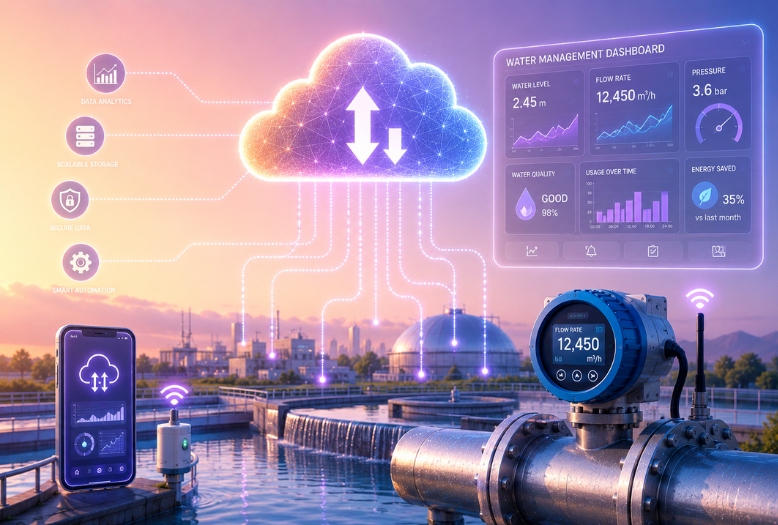
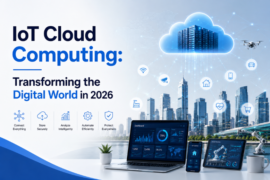
Data Storage and Analytics : The recent infrastructure integrates IoT cloud computing to store a large amount of data and process it. The Digital Flow Meter is a continuous data contributor for analysis and reporting to cloud systems.
Real-Time Decision Making : Furthermore, with the use of cloud infrastructure, organizations can make decisions based on data analysis to achieve optimization and reduce waste. In this process, real-time data is essential, and Digital Flow Meters play a crucial role in delivering it.
Digital Flow Meter Advantages
- When measuring liquid flow, digital flow meters provide a new standard for accuracy and reliability, as do real-time assessments of water flow and consumption and assessments of flow in the system.
- These devices significantly reduce water waste by rapidly identifying leaks, obstructions, and abnormal flow in pipes and provide greater control and efficiency for industrial, commercial, and municipal water management systems.
- Digital Flow Meters also seamlessly connect to IoT-based smart systems, further streamlining automation and allowing more advanced data-enabled operations.
- We enable remote monitoring and control for the user anytime, anywhere. Digital output data improves analysis and reporting, and promotes long-term decisions.
- Less manual operation increases the system’s reliability and reduces the opportunity for human error. In addition, Digital Flow Meters foster predictive maintenance by enabling the early detection of system inefficiencies and support optimized resource consumption through improved system efficiency.
Smart Water Metering Technology
Smart water meters enable real-time monitoring to help businesses and municipalities reduce water consumption.
The Digital Flow Meter is an invaluable tool, due to its precision and consistency in fulfilling a requirement for critical applications.
These technologies are becoming increasingly common in smart cities in IoT environments and modern industrial ecosystems, where connected devices help improve efficiency, automation, and real-time monitoring.
Data-Driven Water Management
Today, modern water management systems are increasingly data-driven. As a result, organizations are using data analysis to identify more efficient ways to manage water consumption.
Insight generation is made possible by the foundational data from Digital Flow Meters. Furthermore, predictive maintenance, resource planning, and management all benefit from these insights.
The Challenges of Conventional Systems
- Data management systems have their share of challenges that include:
- Errors owing to manual data collection
- Inability to monitor data as it is generated
- No mechanisms to report data in a timely manner
- Poor management of available resources
All these issues pose challenges to the attainment of operational efficiency and the attainment of sustainability goals.
The Digital Flow Meter caters to all these challenges by automating data collection and reporting in real time, thus enhancing data accuracy.
The Future of Water Management
- Automation, interconnected systems, and data-driven systems define the future of water management. Digital Flow Meters will be the leading edge in this area.
- Furthermore, advancements in artificial intelligence and Internet of Things technologies are likely to enhance the sustainability and management efficiency of water systems.
- The Digital Flow Meter has revolutionized the digital and automated management of water. Moreover, it addresses the growing demand for accuracy in water management by providing automated and highly efficient data-based management systems.
- As a result, Digital Flow Meters play a major role in various fields of water management as systems become more interconnected and data-driven.
- Water systems management today is highly efficient owing to the combination of numerous technologies.
Final Thoughts
In conclusion, smart water management with digital flow meters is transforming the way industries, commercial facilities, and households monitor and control water usage. By providing real-time data, accurate flow measurement, and automated monitoring, these advanced systems help reduce water waste, improve operational efficiency, and support sustainable resource management. Moreover, businesses can quickly identify leaks, optimize consumption patterns, and lower maintenance costs through intelligent water monitoring solutions.
Furthermore, as water conservation becomes increasingly important across the globe, investing in digital flow meters is no longer just an option but a necessity for future-ready infrastructure. Whether used in industrial plants, smart buildings, or municipal water systems, digital flow meters offer reliability, precision, and long-term value. Therefore, organizations adopting smart water management technologies today will be better prepared to achieve efficiency, sustainability, and cost savings in the years ahead.
FAQs
1. What is a digital flow meter, and how do they work?
Digital flow meters are smart devices used to measure and monitor the flow of liquids through pipes. In addition, they provide highly accurate and real-time flow data. To achieve this, digital flow meters rely on advanced sensors and digital technology. This improves the efficiency of the monitoring process. This also reduces manual error and improves control.
2. Why are digital flow meters critical for smart water management?
Digital flow meters observe flow and perform real-time data loggings. This continuous flow monitoring allows for the broad detection of leaks and helps manage flow control. This ultimately helps manage smart water systems and also helps automation as well as data driven decision making.
3. How does the IoT improve water management systems?
The IoT connects devices, such as sensors and flow meters, to a central monitoring system. Furthermore, this allows operators to monitor the system from a remote location, receive notifications through a control dashboard, and manage the flow system in a more optimized manner.The IoT also promotes predictive maintenance as well as system performance.
4. Are digital flow meters useful for managing water leakage?
Absolutely. Digital flow meters detect sudden drops in flow and negative pressure spikes. This empowers the maintenance team to respond to leaks before significant water loss occurs. This is not only a water saving initiative, but also helps achieve significant cost savings.
5. Where are Digital Flow Meters typically deployed?
Digital Flow Meters find application across various industries, innovative metered neighborhoods, irrigation systems, commercial infrastructures, and municipal water supply systems. Moreover, Digital Flow Meters are needed for industrial automation systems that require precise control over water for the system to operate.
6. Why are Digital Flow Meters preferred compared to traditional Flow Meters?
Moreover,Digital Flow Meters are superior to traditional mechanical meters in that they deliver real-time data, enhanced accuracy, remote data collection, and facilitate the Internet of Things (IoT). Moreover, they reduce manual efforts, increase the accuracy of the reports generated, and foster sustainable water management.