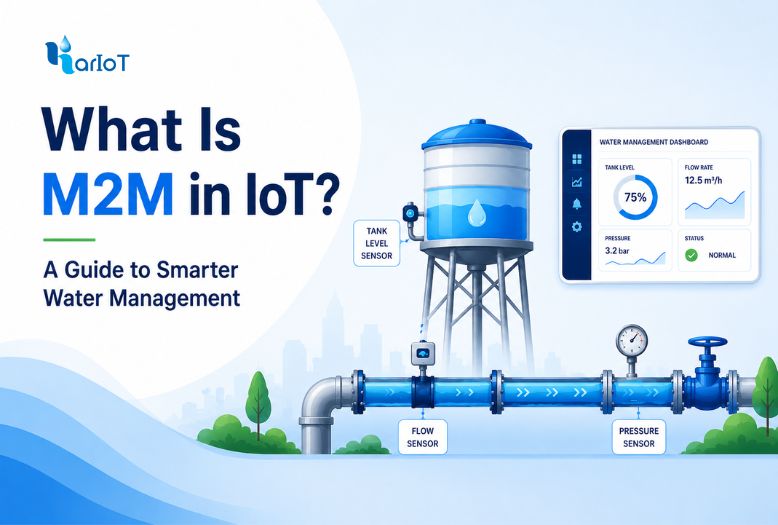
M2M in IoT is making water management easier and more efficient. In the past, water usage was often checked manually, which took time and could delay the detection of leaks or other problems. Today, connected devices can collect and share water-related data in real time. This helps businesses and water operators keep track of usage, find problems early, and reduce water waste.
With smart water management using IoT, devices such as smart water meters, sensors, and IoT gateways can work together to monitor water systems. In this blog, we will look at how M2M works in smart water management, its benefits, the devices involved, common applications, and how IoT can help build better and more efficient water systems.
What Is M2M in IoT?
Machine-to-Machine (M2M) communication allows devices to share data with each other without human help. It helps businesses automate tasks, improve operations, and reduce costs. M2M is especially useful in industries such as manufacturing and logistics, where machines need to work together quickly and efficiently. Today, businesses use M2M technology to improve productivity, work more efficiently, and stay competitive.
- M2M connects smart water meters, pumps, valves, pressure sensors, flow sensors, gateways, and monitoring platforms.
- Sensors can detect changes in water pressure and flow.
- The collected data is sent to an IoT gateway.
- The gateway sends the data to a central monitoring system.
- The system can send alerts when it detects unusual water conditions.
- It can also automatically control pumps or valves based on set rules.
- M2M is useful for large water networks with meters, pipelines, tanks, pumping stations, and treatment plants.
- Remote monitoring reduces the need for manual site visits.
- It helps businesses and utilities save time, reduce costs, and manage water systems more efficiently.
Advantages of M2M
M2M communication helps businesses reduce manual work and improve efficiency. Machines can share data, detect problems, and send alerts without constant human involvement. This allows businesses to respond faster, reduce operating costs, and improve productivity. M2M also provides better control of machines and helps teams make quick decisions using real-time data. Overall, it makes business processes faster, smarter, and more efficient.
Key Components of M2M Technology
M2M systems use different components that work together to collect data, send it, process it, and take action. The main components are:
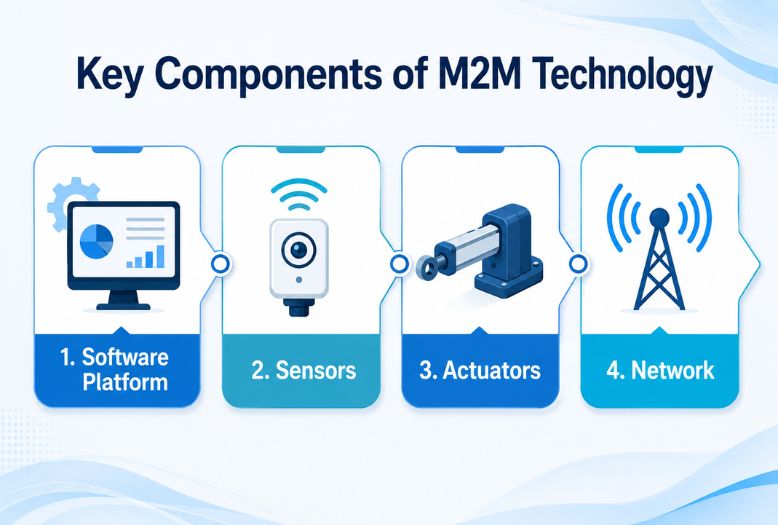
1.Software Platform
The software platform collects, stores, and analyzes data from connected devices. It also helps users monitor devices and view important information in one place.
2. Sensors
Sensors collect information such as temperature, pressure, humidity, water flow, and movement. For example, a water sensor can measure the flow and send the data to another device.
3. Actuators
Actuators take action based on the data they receive. For example, an actuator can turn a pump on or off, open a valve, or adjust a machine automatically.
4. Network
The network helps devices send and receive data. M2M systems can use cellular networks, Wi-Fi, Ethernet, or LPWAN, depending on the application and location.
How They Work Together
Sensors collect the data, the network sends it to the software platform, and the platform processes the information. If action is needed, actuators can respond automatically. This helps M2M systems monitor processes, reduce manual work, and improve efficiency.
Real-World Applications of M2M Technology
M2M communication is used across many industries to automate tasks, reduce costs, and improve daily operations. From logistics and healthcare to manufacturing, smart cities, and water management, connected machines can share data and respond to changes without constant human involvement.
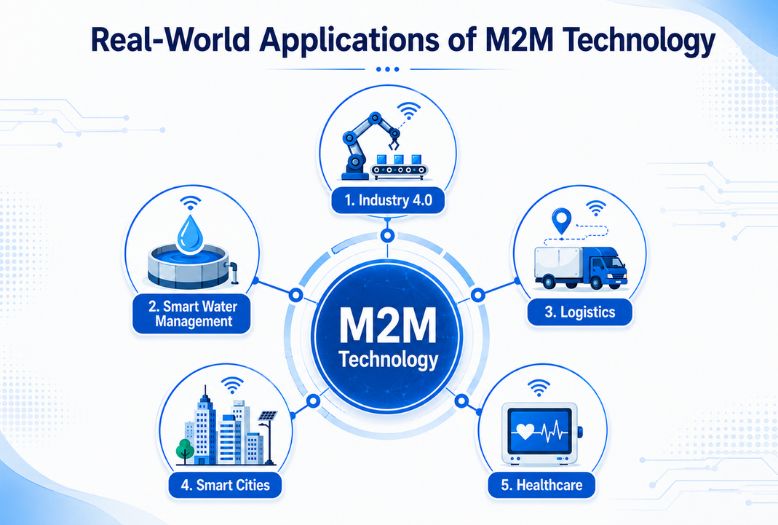
1. Industry 4.0: M2M communication is an important part of smart manufacturing. Machines can share information about their performance and working conditions. This helps companies improve production, reduce downtime, and identify equipment problems before they cause major issues.
2. Smart Water Management: M2M connects smart water meters, pumps, valves, and sensors to monitor water systems. It can help track water usage, detect leaks, monitor pressure, and control equipment remotely, making water management more efficient.
3. Logistics: M2M devices help companies track the location and condition of goods in real time. In warehouses, connected devices can also monitor inventory, record product movement, and reduce errors during daily operations.
4. Smart Cities: M2M technology supports smart meters, street lighting, traffic systems, and parking solutions. For example, smart lights can switch on or off automatically, while connected traffic systems can help improve traffic flow and reduce energy use.
5. Healthcare: Connected medical devices can monitor patients and send important health information to medical teams. Hospitals can also use M2M to monitor medical equipment, identify maintenance needs, and reduce the risk of unexpected equipment failures.
How M2M Works in Smart Water Management?
A smart water management system uses connected devices to collect data, send it, and take action. Here is how the process works:
1. Data Collection
IoT sensors measure things like water flow, pressure, level, and temperature. Smart meters can also track water usage.
2. Data Communication
The collected data is sent through a network such as cellular, Wi-Fi, or LPWAN. This allows devices to share information from remote locations.
3. IoT Gateway
An IoT gateway connects sensors and other devices to the main system. An Edge Gateway can also process some data locally for faster response.
4. Cloud and Analytics
The data is stored and analyzed using IoT cloud computing. Operators can check water usage, view trends, and receive alerts when something looks unusual.
5. Action and Automation
When a problem is detected, the system can send an alert or take automatic action. For example, IoT automation can control pumps or valves when certain conditions are met.
Overall, this process helps make water management simpler, faster, and more efficient.
Differences: M2M vs. IoT
| Feature | M2M | IoT |
| Meaning | Machine-to-Machine communication | Internet of Things |
| Connection | Devices communicate directly | Devices connect through the internet and cloud |
| Main Purpose | Data exchange between machines | Monitoring, analysis, and automation |
| Internet Use | May work without the internet | Usually uses internet connectivity |
| Data Processing | Often limited | Supports cloud and advanced analytics |
| Scalability | Suitable for specific systems | Can connect many devices and systems |
| Example | A water meter sending data to a control unit | Smart water meters connected to a cloud platform |
| Human Involvement | Low | Low, with more options for monitoring and control |
In simple terms: M2M focuses mainly on machine-to-machine communication, while IoT connects devices to the internet, cloud, and wider systems for smarter monitoring and automation.
Benefits of M2M in Smart Water Management
The combination of connected machines and water infrastructure offers several practical benefits.
Real-Time Visibility
One of the biggest advantages of M2M in IoT is continuous visibility. Instead of waiting for monthly or periodic readings, operators can receive data much more frequently.This helps them understand how water is being used and identify unusual behavior earlier. Real-time information is especially useful for large networks where manual monitoring is difficult.
Leak Detection
Water leaks can cause significant losses, especially in large distribution networks. A sudden increase in flow or a pressure change may indicate a possible leak. With an IoT remote monitoring solution, operators can receive alerts and investigate problems before they become larger incidents. Consequently, organizations can reduce water loss and potentially lower repair costs.
Better Water Usage
Accurate data helps organizations understand where and when water is being consumed. This can support better planning and encourage efficient use.In commercial and industrial locations, detailed consumption information can also help identify areas where water-saving measures may have the greatest impact.
Lower Operational Effort
Manual meter readings and frequent site visits can consume staff time. Remote data collection reduces the need for routine physical checks. Instead, teams can focus their attention on locations that require inspection, maintenance, or immediate action.
Predictive Maintenance
Connected equipment can provide information about operating conditions. When pressure, vibration, temperature, or energy behavior changes, the system may identify signs of equipment stress. This supports proactive maintenance and can reduce unexpected downtime. Over time, historical information can also help organizations understand recurring equipment problems.
Faster Response
A connected monitoring platform can send alerts when predefined conditions are reached. Therefore, operators can respond faster to abnormal water usage, pressure problems, pump issues, or other events.
Role of Smart Water Meters
Smart water meters are an important part of connected water infrastructure. Traditional meters mainly show accumulated consumption, while connected meters can transmit readings automatically and support more detailed monitoring.
When smart meters are connected with an IoT device management platform, administrators can also monitor device status, connectivity, configurations, and other operational information. This becomes increasingly important when an organization manages a large number of devices.
IoT Device Monitoring for Water Networks
Managing connected equipment is just as important as collecting water data. IoT device monitoring helps organizations understand whether field devices are online, communicating correctly, and reporting reliable information.
A water utility may have devices installed in underground chambers, remote pumping stations, buildings, and industrial facilities. Some devices may operate on batteries, while others use a fixed power source. Because of this, device health can vary over time.
A strong IoT monitoring process can track connectivity, battery status, data transmission, and device errors. When a device stops reporting, the system can generate an alert.
As a result, maintenance teams can investigate the issue instead of discovering it during a routine inspection. This approach can improve device availability and help maintain reliable data collection.
Smart Water Management in Industrial Environments
Industrial facilities can have complex water requirements. Water may be used for cooling, cleaning, production, boilers, processing, or other operations. A small problem in one area can sometimes affect the wider production process.
This is where industrial IoT can make a difference. Connected sensors can monitor water flow, pressure, tank levels, and equipment conditions across a facility. The data can be combined with production information to understand how water is being used.
IoT industrial automation can also help coordinate equipment more efficiently. For example, an IoT solution can control a pump based on tank levels or pressure conditions instead of using a fixed schedule. This improves process control, reduces unnecessary operation, and helps save resources.
In addition, connected systems can provide operators with a centralized view of multiple water-related processes. This makes it easier to identify inefficiencies and take corrective action.
Main IoT Components in Smart Water Management
A connected water solution may use several technologies, including:
IoT Sensors
IoT sensors capture physical conditions such as flow, pressure, level, temperature, and other relevant measurements. These sensors provide the data required for monitoring and automation.
Smart Water Meters
Smart water meters measure consumption and support remote readings. They can provide frequent data that is useful for usage analysis and leak detection.
Digital Flow Meter
A digital flow meter provides digital measurements of water flow for monitoring and analysis. It can be integrated with a connected system to provide regular flow information.
IoT Gateway
An IoT gateway collects data from field devices and connects them with the wider IoT platform. It can also support protocol conversion and local processing.
Edge Gateway
An Edge Gateway processes selected information close to the source. This can help reduce latency and limit unnecessary data transmission to the cloud.
IoT Cloud Computing
IoT cloud computing provides scalable storage, analytics, dashboards, and remote access. It allows organizations to manage information from multiple locations through a centralized platform.
IoT Device Management
IoT device management helps organizations provision, configure, update, monitor, and maintain connected devices throughout their lifecycle. Together, these components form a flexible technology foundation for modern water infrastructure.
IoT Applications in Water Management
IoT is helping different industries monitor and manage water more easily. Some common applications include:
- Water Usage Monitoring: Smart meters track water consumption and help find unusual usage.
- Leak Detection: Sensors can detect changes in water flow or pressure and alert users about possible leaks.
- Water Treatment: IoT devices can monitor tanks, pumps, valves, and other equipment in treatment plants.
- Smart Irrigation: Sensors can check soil moisture and water levels to provide water only when it is needed.
- Remote Monitoring: A water monitoring system allows teams to check water usage and equipment status from a central location.
- Industrial Water Management: Industries can monitor water used in production, cooling, and other processes to reduce waste.
- Automated Water Control: IoT automation can control pumps and valves based on real-time data.
Overall, IoT helps make water management more efficient, reliable, and easier to monitor.
The Future of Connected Water Management
The future of water management is becoming more connected and automated. Some key developments include:
- Smarter Sensors: Advanced sensors will collect more accurate water and equipment data.
- AI and Analytics: AI can help identify unusual water usage, leaks, and equipment problems early.
- Edge Processing: An Edge Gateway can process data locally, helping systems respond faster.
- Industrial IoT: IIoT can connect industrial water equipment and support better monitoring and automation.
- More Automation: Pumps, valves, and other equipment can respond automatically to real-time conditions.
- Predictive Maintenance: Data can help identify equipment issues before they lead to major failures.
- Better Decision-Making: Clear and useful data will help water operators make faster and smarter decisions.
Overall, the future of water management is focused on saving water, reducing waste, improving efficiency, and making systems easier to manage.
Why Businesses Should Invest in Smart Water Management
| Benefit | How It Helps Businesses |
| Better Water Monitoring | Businesses can track water usage, flow, pressure, and equipment performance in real time. |
| Reduce Water Waste | Early leak detection helps reduce unnecessary water loss. |
| Lower Operating Costs | Remote monitoring can reduce manual inspections and maintenance costs. |
| Better Maintenance | Data can help identify equipment problems before they become major issues. |
| Improved Efficiency | Businesses can use real-time data to improve water and energy usage. |
| Faster Decisions | Accurate data helps teams respond quickly to problems and unusual water usage. |
| Easy to Scale | Businesses can start with a small project and expand the system as needed. |
| Future Automation | Connected water systems can support automation and other IoT applications in the future. |
Overall, smart water management helps businesses save water, reduce costs, improve efficiency, and manage their water systems more effectively.
Conclusion
M2M in IoT provides a practical foundation for connecting machines, sensors, meters, and software systems in modern water infrastructure. By enabling devices to exchange information automatically, organizations can move from manual monitoring toward continuous visibility and smarter decision-making.
As water challenges continue to grow, connected solutions can help organizations build systems that are more efficient, responsive, and sustainable. By combining monitoring, automation, analytics, and reliable connectivity, businesses and utilities can take meaningful steps toward smarter water infrastructure.
Frequently Asked Questions
1. What is M2M in IoT for water management?
M2M in IoT for water management enables connected devices such as meters, sensors, pumps, and gateways to exchange data automatically. This supports remote monitoring, alerts, automation, and better operational decisions.
2. How does IoT help in smart water management?
IoT helps collect real-time information about water flow, pressure, levels, consumption, and equipment conditions. This information can help detect leaks, monitor usage, improve maintenance, and automate selected processes.
3. What devices are used in smart water systems?
Common devices include smart water meters, flow meters, pressure sensors, water-level sensors, pumps, valves, IoT gateways, and edge devices. These components can be connected to a central monitoring or cloud platform.
4. Can IoT detect water leaks?
Yes. IoT-based systems can monitor flow, pressure, and consumption patterns. When the system identifies unusual behavior, it can send an alert so that operators can investigate a possible leak.
5. What is the role of an IoT gateway in water management?
An IoT gateway connects field devices with the wider IoT platform. It can collect data from multiple devices, translate communication protocols, process information locally, and send relevant data to cloud or