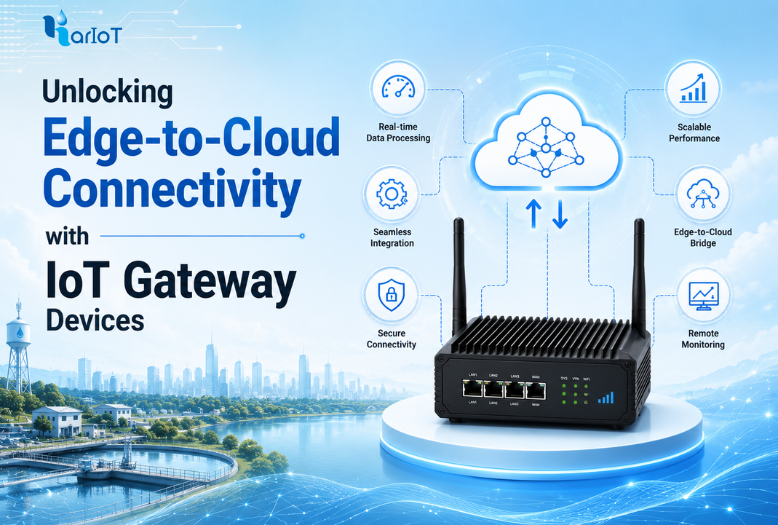
As businesses embrace digital transformation, connected technologies are becoming the foundation of smarter operations. From manufacturing plants to utility networks, organizations depend on real-time data to improve efficiency, reduce costs, and make informed decisions. IoT Gateway Devices play a critical role in this process by connecting field devices with cloud platforms while ensuring secure and reliable data transmission. They bridge the communication gap between sensors, machines, and cloud applications, enabling businesses to monitor operations and respond quickly to changing conditions.
Moreover, these devices help organizations process data closer to where it is generated, reducing latency and improving performance. In this blog, we’ll explore how IoT gateways have become an essential component of modern digital ecosystems across various industries.
What Are IoT Gateway Devices?
IoT Gateway Devices are hardware systems that connect IoT sensors, controllers, and field equipment with cloud-based applications. They collect information from multiple devices, process the data locally, and securely send it to cloud platforms for storage, analytics, and visualization.
Unlike traditional networking equipment, IoT gateways support multiple communication protocols, making them compatible with a wide range of devices. They also provide data filtering, protocol conversion, encryption, and edge computing capabilities to ensure efficient communication between connected assets. As a result, organizations can improve system reliability while reducing network traffic and operational costs.
Why Edge-to-Cloud Connectivity Matters
Today’s industries generate massive amounts of operational data every second. Sending every piece of information directly to the cloud can increase bandwidth usage, create delays, and raise operational costs.
Edge-to-cloud connectivity solves these challenges by processing critical information locally before transmitting only valuable insights to the cloud. This approach improves response time while reducing unnecessary data transfer.
Some key advantages include:
- Faster decision-making
- Lower network bandwidth usage
- Improved system reliability
- Enhanced cybersecurity
- Better scalability for large IoT deployments
Therefore, businesses can achieve real-time operational visibility without overloading cloud infrastructure.
How IoT Gateway Devices Work
The working process of IoT Gateway Devices is straightforward but highly efficient.
Step 1: Collect Data
The gateway receives information from connected iot sensors installed on machines, pipelines, pumps, environmental systems, or production equipment.
These sensors continuously measure operational parameters such as:
- Temperature
- Pressure
- Humidity
- Flow
- Vibration
- Energy consumption
Step 2: Process Data at the Edge
Instead of immediately forwarding all collected information, the gateway analyzes and filters the incoming data.
For example, it can:
- Remove duplicate readings
- Detect abnormal values
- Trigger alerts
- Compress large datasets
This local processing reduces unnecessary cloud communication and improves operational efficiency.
Step 3: Secure Data Transmission
After processing, the gateway securely transfers valuable information to cloud platforms using encrypted communication protocols. This ensures that business-critical information remains protected during transmission.
Step 4: Cloud Analytics
Once the information reaches the cloud, organizations can monitor dashboards, generate reports, analyze historical trends, and automate business decisions using IoT cloud computing platforms. Consequently, decision-makers gain complete visibility into operations from anywhere.
Key Components of an IoT Gateway
A modern gateway consists of several integrated technologies that work together to create a reliable IoT ecosystem.
Multi-Protocol Connectivity
Industrial environments often contain devices from different manufacturers.
An iot gateway supports communication standards such as:
- Modbus
- MQTT
- OPC-UA
- Ethernet/IP
- CAN Bus
- BACnet
Therefore, organizations can integrate legacy equipment with modern cloud platforms without replacing existing infrastructure.
Edge Processing
An Edge Gateway performs local data analysis before sending information to cloud services.
This capability enables:
- Faster response times
- Reduced cloud dependency
- Better operational efficiency
- Lower bandwidth costs
As industries continue adopting digital technologies, edge intelligence becomes increasingly important.
Data Security
Cybersecurity is a major concern for connected infrastructure.
IoT gateways provide:
- Firewall protection
- Device authentication
- Secure boot
- Data encryption
- VPN connectivity
These security features help protect operational technology networks from unauthorized access.
Remote Device Connectivity
Organizations often manage equipment spread across multiple locations.A gateway allows centralized communication with remote assets, making maintenance and monitoring significantly easier.
Major Benefits of IoT Gateway Devices
Modern enterprises rely on IoT Gateway Devices because they deliver measurable business value across various industries.
1. Faster Data Processing
Processing information locally significantly reduces response time. Instead of waiting for cloud servers to analyze every data packet, gateways can instantly detect equipment failures or operational anomalies. This enables quicker corrective actions.
2. Improved Network Efficiency
Large industrial facilities generate enormous volumes of operational data. Gateways filter unnecessary information before cloud transmission, reducing bandwidth usage and lowering communication costs. As a result, cloud resources are utilized more efficiently.
3. Enhanced Security
Sensitive industrial information remains protected through encrypted communication and secure authentication.
Additionally, gateways isolate field devices from direct internet exposure, reducing cybersecurity risks.
4. Easy Device Management
Large IoT deployments may involve thousands of connected devices.
With proper iot device management, organizations can:
- Configure devices remotely
- Update firmware
- Monitor connectivity
- Manage security policies
This simplifies maintenance while reducing operational expenses.
5. Better Scalability
Businesses can start with small IoT deployments and gradually expand without redesigning the entire infrastructure.
Gateways support scalable architectures capable of handling increasing device volumes. Therefore, organizations can grow confidently as operational requirements evolve.
Real-World Applications
IoT gateways are transforming industries by enabling smarter, data-driven operations.
Smart Manufacturing
Factories use iot industrial automation to connect production equipment, monitor machine health, and optimize manufacturing workflows. Real-time insights help reduce downtime while improving production efficiency.
Smart Utilities
Water utilities increasingly rely on connected infrastructure for efficient resource management. A smart water management system integrates sensors, communication networks, and gateways to monitor pipelines, storage tanks, and distribution systems. This enables utility providers to detect issues early and improve service reliability.
Smart Cities
Municipal authorities deploy IoT gateways for street lighting, waste management, traffic monitoring, parking systems, and environmental monitoring. Centralized data collection helps improve urban services while reducing operational costs.
Industrial IoT Architecture: How Everything Works Together
A successful Industrial Internet of Things (IIoT) deployment depends on a well-planned architecture. Every connected device has a specific role, and together they create a seamless flow of information from the physical environment to business applications.
A typical architecture includes:
- Field devices and sensors
- Gateway layer
- Communication network
- Cloud platform
- Analytics dashboard
- Business applications
In this ecosystem, IoT Gateway Devices act as the intelligent bridge between field equipment and cloud services. They collect data from multiple sources, process it locally when required, and then forward meaningful information to cloud platforms.
Smart Water Management: A Real-World Success Story
Water is one of the world’s most valuable resources. However, aging infrastructure, leakage, and inefficient monitoring continue to create major challenges. Fortunately, smart water management using iot is helping utilities modernize their operations.
By installing connected sensors throughout water distribution networks, organizations can continuously monitor:
- Water pressure
- Flow rates
- Tank levels
- Pipe conditions
- Water quality
Instead of relying on manual inspections, operators receive real-time updates through connected monitoring platforms.
Consequently, maintenance teams can identify problems before they become expensive failures.
Improving Water Distribution Efficiency
Modern utilities are also investing in smart water management solutions to improve operational efficiency.
These systems help organizations:
- Detect pipeline leaks quickly
- Reduce water loss
- Monitor consumption patterns
- Improve billing accuracy
- Optimize distribution networks
Furthermore, predictive analytics allows operators to schedule maintenance before equipment failures occur.
This proactive approach saves both time and operational costs.
Monitoring Water Consumption Accurately
Traditional water meters require manual readings, which can be time-consuming and prone to human error.
Today, utilities are replacing them with smart water meters that automatically transmit consumption data.
These digital devices offer several benefits:
- Real-time usage monitoring
- Remote meter reading
- Improved billing accuracy
- Faster leak detection
- Reduced operational costs
When connected through intelligent gateways, water consumption data becomes instantly available to utility operators.
Enabling Remote Operations
One of the biggest advantages of connected infrastructure is remote visibility.
An iot remote monitoring solution enables engineers to monitor equipment from virtually anywhere.
Instead of waiting for technicians to visit each site, businesses can remotely access operational information such as:
- Equipment status
- Alarm notifications
- Energy consumption
- Temperature
- Pressure
- Performance trends
Therefore, organizations can reduce travel costs while responding to issues much faster.
Device Health and Performance Monitoring
Managing thousands of connected devices can quickly become challenging.
With effective iot device monitoring, organizations can track:
- Device availability
- Communication status
- Battery health
- Signal strength
- Firmware versions
- Operational performance
This visibility allows maintenance teams to resolve issues proactively rather than waiting for unexpected failures.
Consequently, overall system reliability improves significantly.
Supporting Modern Automation
Digital transformation is changing how industries operate.
Today, iot automation enables businesses to automate repetitive tasks using real-time operational data.
For example, automated systems can:
- Start backup equipment
- Shut down faulty machines
- Trigger maintenance alerts
- Adjust production settings
- Optimize energy usage
As a result, organizations improve efficiency while reducing human intervention.
Key Considerations When Choosing an IoT Gateway
Selecting the right gateway is essential for building a reliable IoT infrastructure.
Before making a decision, organizations should evaluate several important factors.
1. Communication Protocol Support : Industrial environments often contain equipment from different manufacturers. Choose gateways that support multiple communication protocols to simplify system integration.
2. Processing Capability : Edge processing power determines how much data can be analyzed locally. Higher processing capacity improves response time while reducing cloud traffic.
3. Security Features
Cybersecurity should never be overlooked.
Look for features such as:
- Secure boot
- Data encryption
- User authentication
- VPN support
- Firewall protection
These capabilities help protect connected infrastructure from cyber threats.
4. Scalability : Business requirements change over time. Therefore, organizations should invest in gateways capable of supporting future expansion without major hardware replacements.
5. Remote Management :Remote configuration significantly reduces maintenance efforts. Administrators should be able to update software, monitor system health, and troubleshoot devices without visiting every installation site.
Common Challenges in IoT Deployments
Although IoT offers enormous benefits, organizations often face several implementation challenges.
Data Security
Protecting sensitive operational data remains a top priority.
Strong encryption, authentication, and secure communication protocols are essential.
Device Compatibility
Older industrial equipment may use legacy communication protocols.
Fortunately, modern gateways help bridge compatibility gaps between old and new technologies.
Network Reliability
Industrial environments often experience unstable network conditions.
Local edge processing ensures that operations continue even during temporary internet outages.
Managing Large Deployments
As connected devices increase, system complexity also grows.
Proper planning, standardized architectures, and centralized management platforms simplify large-scale deployments.
Future Trends in IoT Gateway Technology
- Smarter IoT Gateway Devices – Modern gateways are becoming more intelligent with enhanced processing power and advanced capabilities.
- Edge Computing Adoption – More data is processed at the edge, reducing latency, saving bandwidth, and enabling faster decision-making.
- Artificial Intelligence (AI) & Machine Learning (ML) – AI and ML are being integrated into gateways to support predictive analytics, anomaly detection, and automated decision-making.
- Enhanced Cybersecurity – Future gateways will include stronger security features such as data encryption, secure boot, hardware security modules, and continuous threat detection.
- Seamless Cloud Integration – IoT gateways are designed to connect easily with multiple cloud platforms for centralized monitoring, analytics, and data management.
- 5G Connectivity – High-speed 5G networks will improve communication with lower latency, higher bandwidth, and more reliable connectivity for large-scale IoT deployments.
- Scalable IoT Infrastructure – Gateway technology will support the growing number of connected devices without compromising performance or reliability.
- Real-Time Data Processing – Increased edge intelligence will allow businesses to analyze and act on critical data instantly.
- Support for Multiple Communication Protocols – Future gateways will offer broader compatibility with industrial devices and emerging IoT standards.
- Remote Device Management – Advanced remote monitoring, diagnostics, firmware updates, and configuration will simplify the management of distributed IoT networks.
Best Practices for Successful IoT Deployment
Implementing an IoT solution requires more than installing connected devices. A well-planned strategy ensures long-term success and maximizes return on investment.
Consider the following best practices:
- Clearly define business objectives before deployment.
- Select gateways that support multiple industrial communication protocols.
- Prioritize cybersecurity with encryption, authentication, and regular software updates.
- Design a scalable architecture that can accommodate future growth.
- Continuously monitor device performance and network health.
- Train operational teams to effectively manage connected infrastructure.
- Regularly analyze collected data to identify opportunities for optimization.
Following these practices helps organizations build a secure, reliable, and future-ready IoT ecosystem.
Why Businesses Should Invest in IoT Gateway Solutions
Organizations across industries are under constant pressure to improve efficiency, reduce costs, and enhance operational visibility. Investing in IoT Gateway Devices provides a strong foundation for achieving these goals.
By enabling secure communication between field devices and cloud platforms, gateways simplify data collection, improve decision-making, and support automation initiatives. Whether managing manufacturing equipment, monitoring utilities, or overseeing remote assets, gateways help organizations transform raw operational data into meaningful business insights.
Moreover, they reduce network congestion through edge processing, improve system reliability, and simplify the management of connected devices. As businesses continue expanding their digital initiatives, gateway technology will remain an essential component of modern industrial infrastructure.
Conclusion
The future of connected industries depends on reliable, secure, and intelligent communication between physical assets and digital platforms. IoT Gateway Devices make this possible by acting as the bridge between edge devices and cloud applications, ensuring that valuable operational data is collected, processed, and transmitted efficiently.
From improving manufacturing processes to enabling smarter utility management and remote monitoring, gateways support a wide range of applications that help organizations operate more efficiently and make better decisions. As technologies such as edge computing, artificial intelligence, and 5G continue to evolve, the importance of IoT Gateway Devices will only continue to grow.
(FAQs)
1. What are IoT Gateway Devices?
IoT Gateway Devices are hardware systems that connect sensors, industrial equipment, and other IoT devices to cloud platforms. They collect, process, secure, and transmit data, enabling efficient communication between edge devices and cloud applications.
2. Why are IoT gateways important?
IoT gateways improve data security, reduce network bandwidth usage, enable edge processing, support multiple communication protocols, and provide reliable connectivity between field devices and cloud services.
3. Which industries commonly use IoT gateways?
Industries such as manufacturing, water utilities, oil and gas, healthcare, agriculture, transportation, logistics, energy, and smart cities widely use IoT gateways to monitor assets and automate operations.
4. What is edge computing in IoT?
Edge computing processes data close to where it is generated instead of sending everything directly to the cloud. This reduces latency, improves response time, and lowers bandwidth consumption.
5. How do IoT gateways improve security?
IoT gateways protect connected networks through features such as encrypted communication, secure authentication, firewalls, VPN support, and secure boot mechanisms, helping prevent unauthorized access and cyber threats.