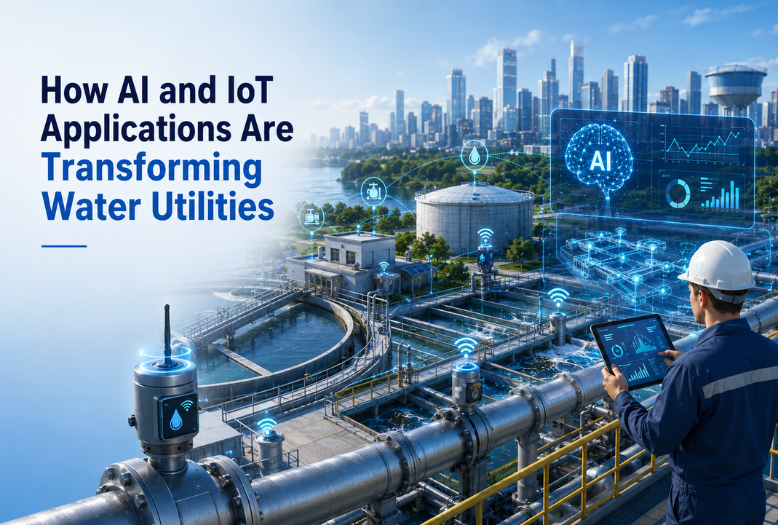
Water is a valuable resource, and for good reason. Unfortunately, many utilities are faced with challenges of aging infrastructure, water loss, rising operational costs, and changing consumer demands. With growing urban populations and more extreme climate conditions, many old methods of managing water no longer work. As a result, water utilities need to rely on new technologies such as iot applications in order to enhance efficiency and sustainability, as well as customer satisfaction and service. Of the many new technologies, Artificial Intelligence (AI) and the Internet of Things (IoT) are particularly disruptive.
With these tools in the hands of water utilities, real-time data is captured and decision-making is automated, with the ability to control the water distribution system and identify problems long before they affect customers. These technologies are also helping companies work toward a more sustainable future and happier customers. The purpose of this article is to show the impact of AI and IoT on the water utility sector, the benefits these technologies provide, and their importance for the future of water management.
Why Water Utilities Need Digital Transformation
- The Internet of Things describes devices that are all connected and can share the information that they collect.
- For water utilities, IoT sensors can collect information about water quality and quantity as well as how water is being consumed and the state of the equipment.
- Information Technology systems relate artificial intelligence to help machines understand the data and, furthermore, generate insights and recommendations for informed and better decisions.
- The water utility can more effectively run its operations by replacing manual inspections with artificial intelligence systems that can predict problems.
- When IoT is used with artificial intelligence, water utility providers can monitor their system in real time, analyze the data, and make quicker decisions.
- This allows the water utility provider to move from waiting for things to break to preventing problems from occurring and maintaining the system in a better state.
How AI and IoT Work Together in Water Utilities
IoT tech collects data from all over the water network. AI looks at the data and decides next steps.
1. Water Leakage and Non-Revenue Water Losses
Water leakage remains one of the biggest concerns for utilities worldwide. Hidden pipe leaks, unauthorized consumption, and inaccurate metering contribute to significant non-revenue water (NRW) losses. These losses increase operational costs, waste valuable resources, and reduce overall system efficiency. Detecting and addressing leaks quickly is essential for improving water conservation and revenue recovery.
2. Aging Pipelines and Infrastructure
Many water distribution networks were installed decades ago and are now reaching the end of their operational lifespan. Consequently, aging pipelines, pumps, valves, and treatment equipment often require frequent maintenance and repairs. Moreover, the deterioration of these assets increases the risk of leaks, equipment failures, and service interruptions. As infrastructure deteriorates, utilities face higher risks of service interruptions, water contamination, and costly emergency replacements.
3. Rising Energy Consumption
Water treatment, pumping, and distribution processes require substantial amounts of energy. Furthermore, as energy prices continue to rise, utilities face increasing pressure to reduce consumption and improve operational efficiency. As a result, many organizations are adopting advanced technologies and data-driven strategies to optimize energy use. Inefficient equipment and a lack of monitoring often lead to excessive energy usage, increasing operational expenses and environmental impact.
4. Increasing Regulatory Requirements
Governments and regulatory bodies continue to introduce stricter standards for water quality, environmental protection, and operational reporting. Utilities must maintain compliance while ensuring accurate documentation and timely reporting. Meeting these requirements can be challenging without modern monitoring and data management systems.
5. Lack of Real-Time Operational Visibility
Traditional monitoring methods often rely on manual inspections and periodic data collection. As a result, utilities may not have immediate visibility into network performance, equipment health, or water quality conditions. This lack of real-time information can delay decision-making and increase the risk of service disruptions.
6. Growing Customer Expectations
Today’s customers expect reliable services, quick issue resolution, and greater transparency regarding water usage and billing. Utilities are increasingly expected to provide accurate consumption data, proactive communication, and improved customer support. Furthermore, customers demand greater transparency and timely access to information regarding their water usage. As a result, utility providers must adopt advanced technologies to meet these growing expectations. Meeting these expectations requires advanced digital tools and connected infrastructure.
Real-Time Monitoring Improves Operational Visibility
IoT devices collect data from various points across the water network, while AI analyzes this information to generate actionable insights.
1. Monitor Infrastructure Continuously
Continuous monitoring enables utilities to track the performance of pipelines, pumps, valves, and storage tanks in real time. Furthermore, smart sensors and connected devices provide instant data on system conditions, allowing operators to maintain constant oversight of the network. As a result, utilities can quickly detect changes in performance and identify abnormalities at an early stage. Moreover, timely detection helps prevent equipment failures and service disruptions. Consequently, continuous monitoring enhances operational reliability, improves maintenance efficiency, and supports effective water resource management.
2. Detect Operational Issues Faster
Real-time alerts allow operators to identify leaks, pressure drops, equipment malfunctions, and other operational issues as soon as they occur. Faster detection reduces response times and minimizes service disruptions. As a result, utilities can prevent small problems from becoming major failures.
3. Predict Equipment Failures
Advanced analytics and predictive maintenance tools help utilities monitor equipment health and performance trends. By identifying warning signs before breakdowns occur, maintenance teams can take proactive action. This approach reduces downtime, repair costs, and unexpected service interruptions.
4. Improve Water Quality Management
Digital monitoring systems continuously track critical water quality parameters such as pressure, flow, temperature, and chemical levels. Real-time data helps utilities quickly identify potential quality concerns and take corrective action. This ensures safe and compliant water delivery to consumers.
5. Optimize Resource Allocation
Accurate operational data helps utilities allocate manpower, equipment, and maintenance resources more effectively. Teams can prioritize high-risk areas and schedule maintenance based on actual conditions. This improves efficiency while reducing unnecessary operational expenses.
6. Enhance Customer Services
Smart water management systems provide better visibility into water usage, service performance, and billing information. Utilities can respond to customer inquiries more quickly and resolve issues efficiently. Improved transparency and communication lead to higher customer satisfaction and trust. When integrated with iot application, utilities can access and analyze information from multiple locations through a centralized platform.
AI-Based Leak Detection Reduces Water Loss
Leakage is one of the biggest costs faced by utility providers, as even the smallest leak can result in significant financial losses and water wastage. However, AI-powered leak detection technologies help address this challenge by continuously monitoring data from sensors. Moreover, these systems analyze large volumes of data to identify unusual patterns that may indicate leaks.
As a result, utility operators can detect problems at an early stage and take corrective action promptly. Moreover, these technologies can identify abnormal patterns that may indicate the presence of a leak. As a result, utility operators can detect and resolve issues more quickly before they become severe. Consequently, AI-based leak detection improves operational efficiency, reduces costs, and supports effective water conservation.
Key Benefits of AI Leak Detection
- Quickly find leaks
- Reduce waste
- Cut maintenance costs
- Increase efficiency
- Improve infrastructure
- Conserve resources
- IoT can help utilities manage data from many thousands of sensors, making leak detection fast, accurate, and scalable.
Smarter Asset Maintenance with AI and IoT
Most maintenance methods fall under two categories: scheduled maintenance or reactionary maintenance. Those methods can be costly, inefficient, and ineffective.
With the aid of AI, Predictive maintenance can determine the state of health of an asset and find faults before an asset reaches failure.
Utilities can monitor the:
Performance of Motors
Vibration of Pumps
Fluctuations in Temperature
Fluctuations in Energy Consumption
Pressure Variations
Benefits include:
- Less downtime
- Lower costs for repairs
- Longer lifespan of assets
- Greater reliability of operations
- IoT is also the reason maintenance teams can obtain immediate data on an assets state and can make advanced decisions.
Enhancing Water Quality Through Smart Technologies
Maintaining Water Quality is an important task of every utility provider.There are many IoT sensors that can be used to monitor:
- pH
- Turbidity
- Cl Chlorine
- Temperature
- Dissolved Oxygen
Benefits of Smart Water Quality Management
- Quality Monitoring
- Automated notifications
- Compliance with Regulations
- Faster Quality Responses
- Greater Trust
- Safer Water
- Guards Safety
- Smart Water Management Systems allow utilities to deliver safer water and maintain their customer trust.
Smarter Water Distribution Networks
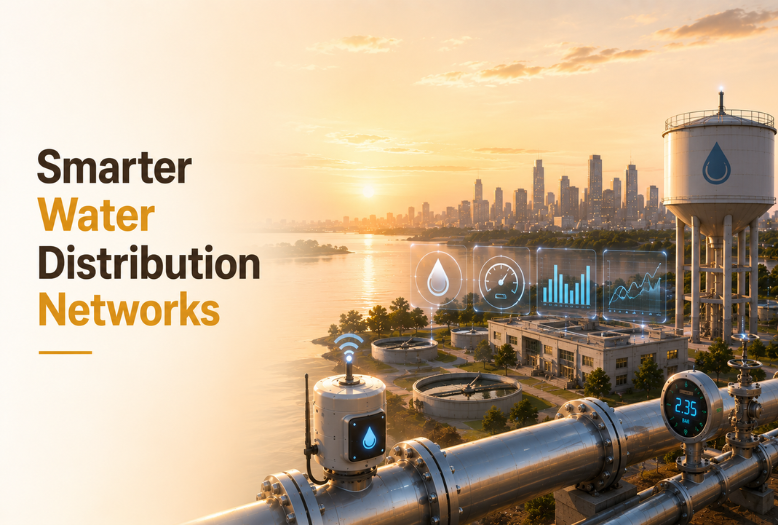
Water Distribution Networks require Monitoring and Management to ensure reliable service. AI and IoT give Utilities the ability to optimize their operations and manage their networks to reduce losses and improve their overall performance.
1. Forecasting Demand : AI examines historical data and weather patterns to estimate future water demands. This prediction allows utility companies to prepare and avoid water shortages.
2. Managing Supply Pressure : AI helps maintain the pressure in the water supply network. This reduces leaks and breaks, and prevents service supply interruptions.
3. Optimizing Energy Use : Smart analytics control the system’s water pump and power requirements. As a result, utility companies use less power and improve system performance and efficiency.
4. Seeing the Network in Real-Time : IoT sensors monitor water flow rates, supply network pressure, and equipment performance in real time. Furthermore, these sensors continuously collect and transmit data from various points across the water distribution network. As a result, utility staff gain greater visibility into system operations and can quickly identify potential problems in the water supply.
5. Choosing Faster : Using real-time data and AI insight, utility companies respond to problems with greater speed. This is better for the company and water management.
The Importance of Connected Devices
At this point connected devices are essential to most water utility operations.
Some common IoT devices are:
– Sensors
– Smart meters
– Controllers
– Communication modules
– Monitoring equipment
Even with all the devices, operations can be ineffective if the devices are not properly managed.
The Impacts of Device Management
There are many benefits to managing IoT devices.
Some of the benefits are:
– Consistent device performance
– Better cybersecurity
– Less downtime
– More accurate data
– Easier device updates and maintenance
Also, IoT gateways provide communication between the devices in the field and the centralized systems, providing the assurance of accurate data.
The Role of AI and IoT in Water Conservation
Water utility operations are becoming increasingly concerned with environmental sustainability. Furthermore, AI and IoT can aid in sustainability in a number of ways.
- Less Water Wasted : With monitoring devices installed throughout water utility networks, leaks can be detected much more quickly, thereby minimizing water waste. Furthermore, real-time monitoring enables utility operators to identify issues as soon as they occur. As a result, repairs can be carried out promptly, reducing water loss and operational costs. Moreover, early leak detection helps maintain the reliability and efficiency of the water distribution system. Consequently, water utilities can improve resource management and support long-term water conservation efforts.
- Less Energy Usage : With the same monitoring systems in place the water utility operations can decrease the usage of electric powered equipment and reduce the costs of operation.
- More Effective Use of Resources : With the data provided by IoT devices in the field, water utility operations can allocate maintenance and labor resources better.
- Improved Environmental Compliance : If water utility operations are continuously monitoring and automatically reporting their operations, then they can stay within environmental regulations with less chance of reporting a violation.
Building Resilient Water Infrastructure for the Future
Smart water management using IoT devices allows water utility organizations to monitor environmental conditions, identify problems within their infrastructure, and support water conservation efforts. Furthermore, connected devices enable the continuous collection of data from various sources. As a result, water utilities can analyze this data in real time to gain valuable insights into system performance. Moreover, real-time monitoring helps operators make informed decisions and respond quickly to potential issues. Consequently, water utility operations can manage their resources more efficiently, improve service reliability, and promote sustainable water usage.
- Equipment malfunctions
- Natural calamities
- Unpredicted weather
- Disruption to supply chains
Artificial Intelligence is a valuable tool for improving resilience because it can predict disruptions to operations. Continuous monitoring of critical infrastructure is made possible through IoT device management.
Benefits include:
- Rapid detection of issues
- Less interruption of service
- Improved response to emergencies
- Greater reliability of operations
- Utilities can better ensure the reliability of the services they provide.
Industrial IoT Is Driving the Next Wave of Innovation
The Industrial IoT is rapidly being adopted in the water utility sector. Industrial IoT provides the ability to: monitor infrastructure and resources from a distance, automate processes, and have a predictive capability for maintenance, operational intelligence, and analytics in real time. Compared to traditional monitoring systems, Industrial IoT provides Infrastructure Utilities a better view that can greatly scale. Industrial IoT will be integral as utilities continue their ongoing digital transformation to enhance operational efficiency and lower costs.
Future Trends in Water Utility Management
Continual improvement of AI and IoT will lead the future of water utilities and the following emerging trends:
- Automation driven by AI
- Digital twins
- Edge computing
- Enhanced analytics
- Self-operating systems
- Predictive operations
A fully integrated smart water management approach will enable water utilities to adapt to constantly changing user demands, motivated by climate disruptions.
In the future, IoT applications will continue to drive innovation in water utilities. For example, centralized management, elastic analytics, and real-time collaboration will become integral components of utility networks.
Moreover, these technologies will enable more efficient monitoring and control of water infrastructure. As a result, utilities will be able to improve service delivery, optimize resource utilization, and respond more effectively to operational challenges. Consequently, IoT will play a crucial role in creating smarter, more resilient, and sustainable water management systems.
Final thought
AI and IoT are changing the entire landscape for water utilities by creating systems and methods that are smarter, faster, and more efficient. Technologies for real-time monitoring, predictive maintenance, and water quality management, as well as leak detection, provide clear operational advances. As more utilities embrace IoT, applications will expand utilities’ capabilities for large-scale data collection, processing, and analysis, resulting in better decisions, greater sustainability, and better services for customers.
Utilities that adopt AI and IoT will be able to more effectively respond to the water challenges of the future in order to save money, avoid spending unnecessary resources, and create adaptive systems that are sustainable over time. The digital transformation of water utilities is not a future idea, but a current reality that will determine the strategies and methods for the management of water resources throughout the world.
FAQ,s
1. What is an IoT application in water utilities?
An IoT application in water utilities enables water service providers to efficiently manage water services and infrastructure through connected devices and systems. Moreover, it facilitates the continuous collection of real-time data from various points along water pipelines, allowing utilities to monitor system performance and detect issues promptly. As a result, operators can improve operational efficiency, reduce water loss, and enhance service reliability. Furthermore, the insights gained from this data support better decision-making and proactive maintenance, ultimately leading to more sustainable and cost-effective water management. It also allows water utilities to gain operational control and improve service.
2. How does an IoT Application Assist in Leak Detection?
Using an IoT application combines the power of sensors with AI for analytics. Furthermore, an IoT application in leak detection identifies abnormal patterns in water consumption and detects leaks in real time. As a result, water utilities can respond quickly to potential issues and minimize water loss. Moreover, the continuous monitoring and analysis of data improve operational efficiency and support proactive maintenance. Consequently, these capabilities contribute to more reliable and sustainable water management.Because of this, utilities act faster and save more water and money.
3. How does the IoT Application Benefit Water Utilities?
An IoT application in water utilities is beneficial for many reasons. Initially, it helps with the cost of services and the efficiency of operations. Also, it helps with the quality of water and maintenance. Finally, it is beneficial for the satisfaction of customers and the environment.
4. In What Ways does AI Support Water Management Systems?
AI supports water management systems by analyzing the data collected from a multitude of sensors and management systems. Moreover, AI tools can identify patterns and trends that may not be easily detected through traditional methods. As a result, water utilities can make more informed decisions and respond to issues more quickly. Furthermore, these insights help optimize resource allocation and improve operational efficiency. Consequently, AI enables the management of water services in a more timely, effective, and sustainable manner. Water utilities no longer have to rely on the management of the service in a reactive way, but can provide a more proactive and timely service.
5. Why is Continuous Monitoring Critical in Water Utilities?
Continuous Monitoring is of the utmost importance in water utilities because it provides an immediate insight into how the systems are operating. Water utilities would want to know immediately if there are leaks, if the pressure has dropped or if a component has failed. This also helps water utilities provide a timely service to their customers.