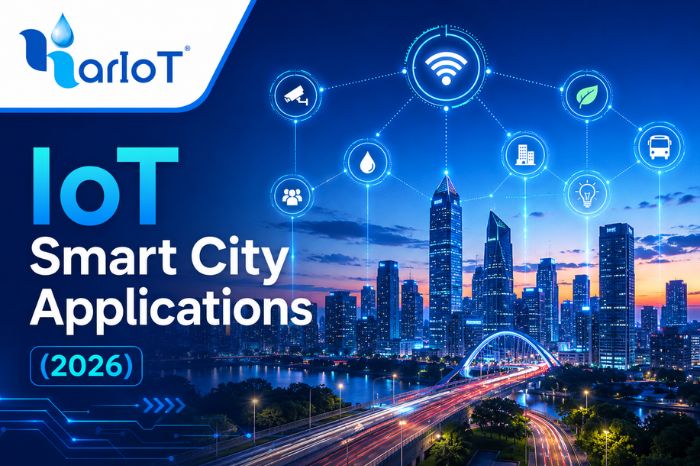
IoT or the Internet of Things connects devices to the internet. IoT sensor applications are endless and continue to grow. They are used in the agriculture industry, construction, shipping, transportation, healthcare and home automation to name a few. IoT can connect multiple systems and make large scale changes. It can help large infrastructure projects such as smart buildings, and can help a city become a Smart City by connecting and automating traffic systems, power, water and waste management.
IoT sensors help organizations gain information about their environment, operate systems in an automated way, and respond to changing conditions in real time. They are small, wireless and connect via the cloud. They enable a cost efficient way to automate processes at scale. IoT sensors can be purchased to measure and detect nearly anything, and can help streamline and improve almost any system or process. Many companies provide them, and prices have become more competitive over the last few years.
For example, temperature sensors are used to detect and alert workers when a machine in a factory reaches a dangerous operating temperature, or if water levels in a tank become too low, or if an area is too dark and lighting is needed. Motion and presence sensors can be used to detect if an area is occupied or not.
There are many types of IoT sensors that can be used to detect just about anything, making the potential use cases endless.
What are IoT Sensors?
Anything that is capable of transforming a physical world stimuli or an event into a signal can be considered as an IoT sensor. This includes measuring or sensing parameters like acceleration, color, temperature, touch, pressure, sound, position, or humidity.
For example, an increasing temperature in a factory machine can be recorded by a temperature sensor. The sensor can send this information to an IoT system. If the temperature further increases to a danger level, the system can send out a signal to alert the user and can even take an action to shut off the factory machine.
A basic IoT sensor system consists of:
- Sensor: It can measure and sense environmental stimuli.
- IoT device: This interprets the sensed information by the sensor and sends it to the next element in the system.
- Gateway: It connects the sensors and IoT devices to the network and transports the data to the next element in the system.
- Cloud/Platform: It stores and processes the data.
- Dashboard: It presents the data to the user.
- Alert System: It sends a signal when there is an anomaly in the data.
Different types of sensors are used based on the magnitude of the factor that needs to be monitored.
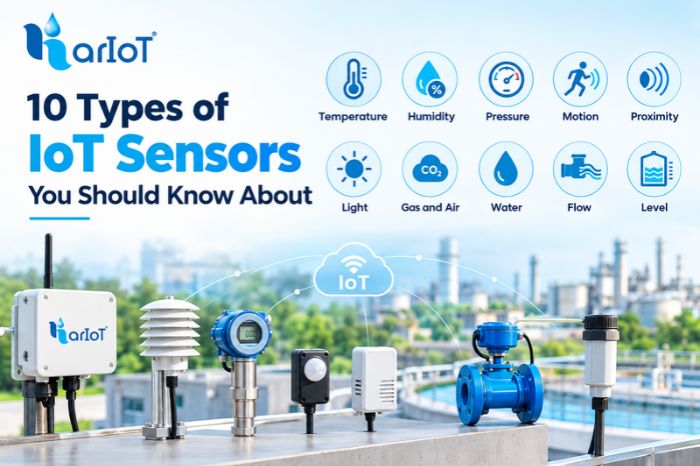
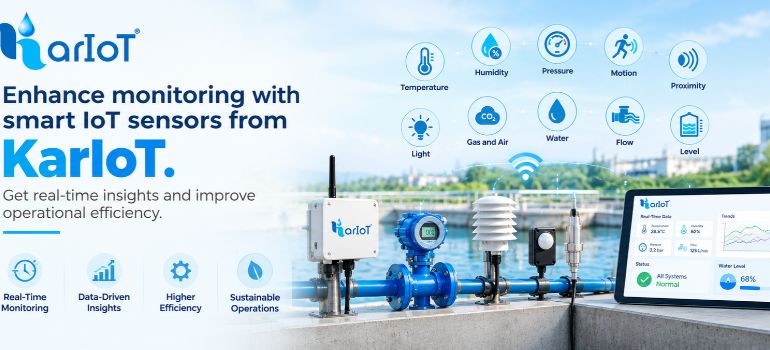
10 Important Types of Sensors in IoT
1. Temperature Sensors
As mentioned above, temperature sensors are the building blocks of IoT. Temperature sensors measure the temperature of machines, objects, environments, liquids, etc. and send the temperature information to an IoT system that users can access from a remote location.
Temperature sensors can be found in:
- Manufacturing
- HVAC
- Data centers
- Healthcare
- Smart Homes
- Agriculture
- Cold storage
- Food storage
Food and drug storage facilities can use temperature sensors to monitor the storage conditions of the drugs and foods. If the temperature goes up, the system can be programmed to notify the user or control the environment.
IoT in Agriculture allows farmers to use sensors to monitor and improve environmental conditions for crop growth, and temperature and humidity sensors can be used for that purpose.
2. Humidity sensors
Humidity sensors measure the level of moisture in the air. Ideally, humidity and temperature sensors should be used together.
High or low humidity can negatively impact equipment, buildings and crops.
Humidity sensors are found in:
- Growth houses/green houses
- Smart buildings
- HVAC
- Food storage
- Pharmaceutical facilities
3. Pressure sensors
Pressure sensors are used to measure the force of a gas or liquid. They can be used to measure levels of equipment, pipelines and tanks. In an IoT system, a pressure sensor can be used to continuously send data to an IoT platform. If the measured pressure goes out of the expected range, the system can notify the user and control the environment.
Typical uses
Examples of uses of pressure sensors include:
- Manufacturing
- Water management
- Oil & Gas
- Industrial Equipment
- HVAC
- Automotive
A water management system can use pressure sensors to determine if the pressure in a pipeline changes. For example, if the pressure in a pipeline drops, that could indicate a leak or other problem in the system.
Data from the sensor can be sent via the IoT gateway to allow operators to monitor the sensor from anywhere and to view data from several locations on a single screen.
4. Motion Sensors
These sensors detect motion in a particular area. They are used in a variety of systems, including security, building and industrial automation. One type of motion sensor is the Passive Infrared (PIR) sensor. These sensors detect changes in infrared radiation and are used to sense the presence of people or other living things in their surrounding area.
A few common uses of motion sensors are:
- Security systems
- Smart homes and buildings
- Industrial safety
- Asset management
- Energy management
For example, a motion sensor could be used in a smart lighting system to sense the presence of people in a room and turn the lights off if nobody is in the room.
Connected public spaces as part of a smart city initiative in an IoT project can use motion sensors to track and gather data on public spaces, buildings, parking, and street activities.
5. Proximity Sensors
Proximity sensors determine if an object is present or not without physically touching it. They are widely used in automated systems and factories. The type of sensor used dictates what methodology is used to detect an object. They can use sound, electromagnetic fields, or light.
Proximity sensors are used in:
- Manufacturing
- Robotics
- Automation
- Smart Parking
- Warehouses
- Conveyor systems
- Security
For example, in a manufacturing system, a machine can use a proximity sensor to determine if a product is in the correct position on a conveyor belt.
The IoT system can record the event and then activate the next step in the process, allowing the system to be fully automated.
6. Light Sensors
Light sensors, as the name suggests, measure light. They can be utilized to switch on or off appliances in an IoT ecosystem based on the surroundings’ lighting conditions.
Light sensors help in automating homes and offices to some extent.
Some common uses cases for light sensors are:
- Lighting
- Smart homes
- Smart buildings
- Street lighting
- Agriculture
- Security systems
- Display systems
Smart street lighting can utilize light sensors to know if it’s day or night and turn on/off lighting accordingly.
Through connected systems, light sensors help accomplish Smart City projects with IoT by helping city councils gain control over streets lighting systems and reduce wasteful energy consumption.
7. Gas and Air Quality Sensors
As the name suggests, gas and air quality sensors measure air and different gases. These sensors are extremely important to the safety and security of human lives in case of air pollution or presence of dangerous gases.
Depending on the case and application, these sensors can be used to monitor carbon monoxide, carbon dioxide, methane, etc.
Some common use cases of these sensors are:
- Industrial facilities
- Smart buildings
- Environmental monitoring
- Mining
- Healthcare
- Agriculture
- Fire and safety systems
Gas sensors in an industrial facility can alert workers of dangerous gas levels in case of an emergency.
Air quality sensors in different parts of a city can help collect important environmental data. Combined with connected systems, analytical engines and other IoT infrastructure, these data can help realize numerous IoT applications related to the environment and public safety.
8. Water Quality Sensors
Water quality sensors measure the quality of water. The sensors can be used to measure different parameters depending on the case in hand.
Some parameters include:
- pH
- TDS
- Chlorine
- Temperature
- Conductivity
- Dissolved Oxygen
- Turbidity
Water quality sensors measure the above mentioned parameters and send the data to an IoT platform.
Some uses include:
- Smart water management
- Industrial facilities
- Water treatment plants
- Farming
- Aquaculture
- Commercial buildings
- Municipal water systems
For example, an IoT water quality monitoring system can be used to monitor the pH of water. If the pH of the water moves out of the required range, the system can send a notification.
Water quality monitoring is important in farming and irrigation to see how the water quality affects the crops and to efficiently manage irrigation. Therefore, water quality sensors are important in the Internet of Things in Farming.
9. Flow Sensors
Flow sensors measure the flow of liquids and gases. They are commonly used in water monitoring and in industries.
A flow sensor is used to measure how much water or other fluids move through a pipeline over a specific time period.
Some uses include:
- Water management
- Manufacturing
- Irrigation
- Water treatment
- HVAC systems
- Industrial pipelines
- Commercial buildings
For example, a smart water management system can be used to monitor the flow of water through different systems and determine water consumption.
The system can detect an unusual flow when water consumption should be low, and can indicate a leak.
Combined with other IoT sensors, flow sensors can increase the understanding of water consumption and system performance. An IoT Gateway can collect information from multiple flow sensors and forward the information to a centralized control room.
10. Level Sensors
Level sensors can measure the amount of material in a container, tank or other storage system. They can measure liquids, powders or other material. Level sensors coupled with IoT technology can allow users to measure the level of material in a tank from a remote location.
Level sensors are widely used in:
- Water tanks
- Fuel tanks
- Chemical storage tanks
- Waste management
- Agricultural tanks
- Other industrial tanks
For instance, let’s take a smart water tank. A level sensor can be placed in the smart water tank to determine the amount of water in the tank. If the level goes down too much, the sensor can send an alert.
If needed, the level sensor can be connected to an automatic pump to keep the level of the water in the tank at a desired level.
This type of monitoring can be of good use in industries, buildings, farms and other places where a reliable source of water is important.
How Do Sensors in IoT Work?
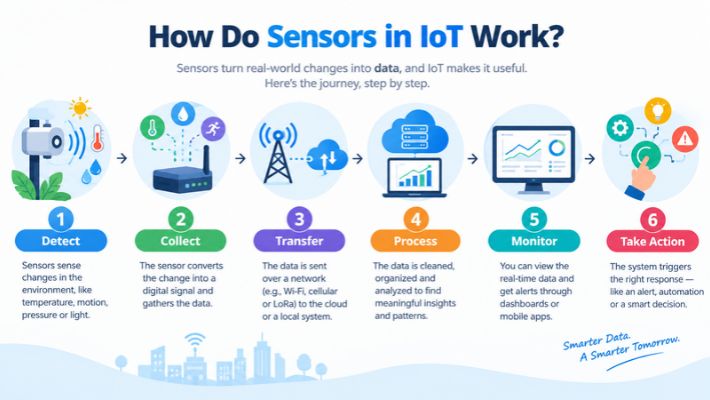
The working process of IoT sensors is pretty straight forward.
Step 1: Detect
Sensors detect various physical conditions in the environment (i.e. movement, pressure, temperature, water flow, etc.)
Step 2: Collect
The sensor converts the physical condition into a form of data that can be understood by an IoT device.
Step 3: Transfer
The data is transferred through a communication network (i.e. Bluetooth, Wi-Fi, cellular, LoRaWAN, etc.)
Step 4: Process
The IoT platform collects and analyzes the data. Rules or analytics can be used to discover abnormal situations.
Step 5: Monitor
The information is made available to the user through a dashboard or via a mobile app or supervisory control and data acquisition (SCADA) system.
Step 6: Take Action
If an abnormal situation occurs, the system may take an action or alert the user.
For example:
Water Flow Sensor → IoT Gateway → Cloud Platform → Data Analysis → Leak Alert
This architecture allows organizations to monitor equipment or systems without needing to physically verify the status of each piece of equipment.
Why Are IoT Sensors Important?
Internet of Things (IoT) sensors collect data from systems and environments.
Continuous, real-time monitoring
Sensors collect data and provide information that can be reported in real time, eliminating the need for personnel to manually check systems and equipment.
Proactive Issue Detection
Sensor data can provide early indication of abnormal situations. For example, pressure and temperature sensor data can detect situations which could lead to an equipment failure.
Meaningful Resource Utilization
Through the use of sensors, businesses can gain visibility into how and when resources are being consumed. For example, to detect inefficient or unnecessary energy usage, or to measure water consumption.
Automation
With sensor data, actions can be triggered automatically, eliminating the need for human intervention.
Improved Safety
Through the use of sensors, conditions that could become unsafe can be identified and reported.
Data-Driven Decision Making
Continuous data can be reported and made available to personnel to evaluate or take action.
Choosing The Right IoT Sensor
The choice of sensor depends on the application and data requirements.
Before making a selection, consider the following.
1. What Do You Need to Measure?
The first step is to identify the condition that you need to monitor. Is it temperature? Humidity? Pressure? Water Flow? Water Quality? Movement? Or something else?
2. Accuracy
Depending on your application, how precise does the sensor need to be?
3. Measurement Range
Will the minimum and maximum values be within the measurement range of the sensor?
4. Environment
What kind of environment will the sensor be exposed to? In an industrial environment, will the sensor come in contact with dust? Moisture? Chemicals? Heat?
5. Connectivity
Can the sensor communicate with your selected IoT network?
6. Power Requirements
Would a battery powered sensor be suitable for a remote location? Would a wired sensor be suitable for a fixed location?
7. Scalability
Would the IoT system be able to support additional sensors that may be added in the future?
IoT Sensors Across Different Industries
IoT sensors are not limited to one industry. They can support many different applications.
| Industry | Common Sensors | Example Use |
|---|---|---|
| Manufacturing | Temperature, pressure, proximity | Machine monitoring |
| Agriculture | Humidity, temperature, soil sensors | Crop monitoring |
| Water Management | Flow, pressure, pH, level | Water monitoring |
| Healthcare | Temperature, motion, pressure | Patient and equipment monitoring |
| Smart Buildings | Motion, light, temperature | Energy management |
| Logistics | Temperature, motion, location | Shipment monitoring |
| Energy | Temperature, pressure, current | Equipment monitoring |
| Environmental Monitoring | Air quality, gas, temperature | Pollution monitoring |
As more industries adopt connected technologies, these sensors are becoming an important foundation for new IoT Applications. Agriculture, for example, can combine soil, temperature, humidity, and water sensors to create more efficient farming systems.
The Future of IoT Sensors
- Current IoT sensor technology continues to improve. Today’s systems can connect more devices and users, and can process more data, faster. As IoT sensor systems continue to develop, they will likely be more intelligence systems.
- The pairing of IoT sensors with AI and ML will continue. AI in IoT will improve the analysis of sensor data. Systems will be better at identifying patterns and have the capability to make predictive decisions.
- Instead of just collecting data, systems will be able to analyze the data, identify patterns, and make decisions. Ultimately, systems will be able to make more decisions on their own.
- Many of these technologies will help with predictive maintenance. Continuous analysis of equipment sensor data will help identify potential equipment issues before a failure occurs.
- Smart water systems can also use similar technologies to analyze pressure, flow, and level data and detect leaks. Other systems can combine water quality and level data to predict equipment failure or leaks in water systems.
- As edge computing continues to improve, data can be processed closer to the source, allowing sensor systems to respond quicker to changes. The use of edge computing will also reduce the amount of data transmitted to the cloud.
- Combined with artificial intelligence (AI), edge computing, cloud platforms, connectivity and analytics, IoT Sensors can augment real-time monitoring and automated decision-making.
Final Thoughts
IoT sensors play a pivotal role in many connected systems. They allow real-world data to be collected by things ranging from machines to buildings to water systems to farms. Temperature and humidity sensors can be joined by flow and level sensors as well as pressure, water quality and other type sensors. Each performs a specific function.
IoT sensors connected to gateways and enhanced with edge computing, cloud, dashboards, and analytics, empower organizations to monitor, detect and resolve problems before they impact the system. This helps improve real-time operations and decisions.
As the Internet of Things (IoT) proliferates, so too will the importance of sensors in IoT in diverse industries including manufacturing, agriculture, healthcare and water management.
FAQs
1. What is an IoT sensor?
An IoT sensor is a small device that checks things around it, like heat, light, or movement. It then sends this information to the internet so people or machines can use it.
2. How does an IoT sensor work?
The sensor collects data from its surroundings. It sends the data to a cloud or an app through Wi-Fi, Bluetooth, or a mobile network. Then the data is shown to you or used to take action.
3. Where are IoT sensors used?
They are used in many places, such as smart homes, hospitals, farms, factories, cars, and cities. For example, a sensor can tell a farmer when the soil is too dry.
4. What are some common types of IoT sensors?
Some common ones are temperature sensors, motion sensors, light sensors, humidity sensors, pressure sensors, and proximity sensors. Each one measures a different thing.
5. Do IoT sensors need power to work?
Yes, but they use very little. Many run on small batteries for months or even years. Some also use solar power.
6. Are IoT sensors safe to use?
Yes, they are mostly safe. But because they connect to the internet, they can be hacked if they are not protected. Use strong passwords and keep the device software updated.