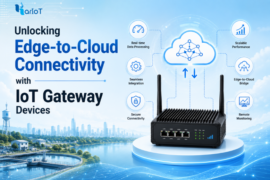
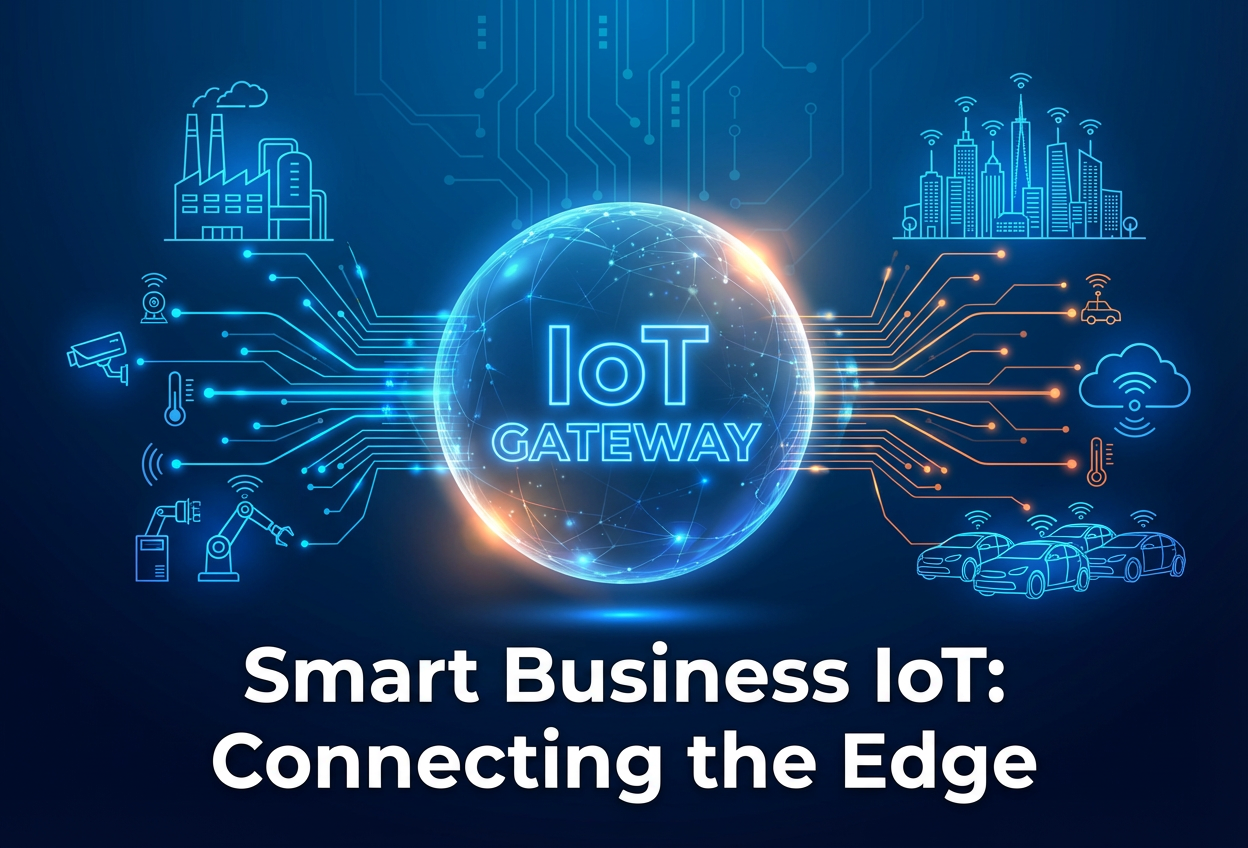
In today’s digital age, businesses are increasingly shifting to smart systems in order to boost productivity, reduce costs, and make more informed decisions. In this context, the IoT Gateway device is one of the key elements driving this change. IoT gateways are essential for managing devices and data in a variety of settings, from smart factories to connected healthcare systems.
This comprehensive tutorial describes what an IoT gateway device is, how it works, Furthermore, businesses require an IoT gateway because it not only centralizes data but also facilitates efficient IoT device monitoring. Consequently, in real-world applications, this enables seamless communication between devices and improved operational management
Understanding IoT in Simple Terms
The Internet of Things (IoT) refers to a network of physical devices that are connected to the internet as a result, these devices can collect, share, and exchange data automatically. These devices collect and exchange data.
Examples include:
- Smart sensors
- Industrial machines
- Wearable health devices
- Smart home appliances
However, most IoT devices cannot directly communicate with cloud servers. This is where IoT Gateway becomes essential.
IoT Device Explained: Meaning, Uses, and Benefits
In essence, IoT is a hardware or software solution that not only connects IoT devices to the cloud but also integrates them with central systems. It acts as a bridge between devices and data platforms.
Simply put, it:
- Additionally, it collects data from IoT devicesProcesses and filters the data
- Moreover, it sends useful information to the cloud
- It first receives commands and subsequently sends them back to devices
Without an IoT gateway, however, managing large numbers of connected devices would be difficult and inefficient.
Why IoT Gateways Are Important for Businesses
In today’s fast-paced digital landscape, modern businesses rely heavily on real-time data. Therefore, an IoT gateway plays a crucial role by ensuring that this data flows securely and smoothly across connected systems.
Key reasons why businesses need an IoT Gateway include:
- As a result, better control over connected devicesFaster data processing
- As a result, network load is reduced Improved security
- Reliable iot device monitoring
As IoT ecosystems continue to grow, therefore, gateways are becoming a core part of digital infrastructure
How an IoT Gateway Works
The working process of an Gateway can be broken down into simple steps:
1. Device Connectivity
- IoT devices use different communication protocols such as Bluetooth, Zigbee, Modbus, or LoRaWAN.
- As a result of supporting multiple protocols, the gateway is able to connect these devices effectively.
2. Data Collection
Firstly, the gateway gathers raw data from sensors and devices, and then it prepares this information for further processing
3. Data Processing
- Instead of sending all raw data to the cloud, the gateway filters and processes it locally.
- This reduces bandwidth usage and speeds up decision-making.
4. Data Transmission
Consequently, only meaningful and structured data is sent to cloud servers or enterprise systems
5. Command Execution
First, the gateway receives instructions from the cloud; then, it forwards them back to the IoT devices
Key Functions of an IoT Gateway
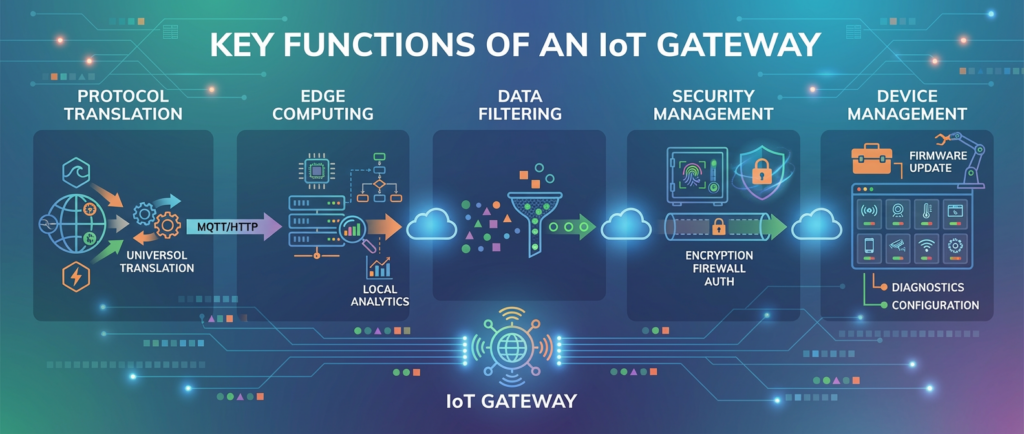
An Gateway does more than just data transfer. It provides multiple smart functions.
Protocol Translation
Different devices speak different “languages.”
The gateway translates these protocols into a common format.
Edge Computing
Data is processed at the edge instead of relying only on the cloud.
By doing so, this reduces latency and thereby enhances system performance.
Data Filtering
Unnecessary data is removed before transmission.
As a result, this saves storage and network costs.
Security Management
Additionally, the gateway encrypts data and ensures secure communication.
Device Management
Moreover, it helps with device registration, facilitates updates, and, in addition, supports IoT device monitoring
Types of IoT Gateways
Additionally, different types of IoT gateways exist to address diverse business demands
Hardware IoT Gateways
These are physical devices installed on-site. As a result, they are commonly used in factories, warehouses, and smart buildings.
Software IoT Gateways
In fact, these are virtual gateways running on servers or cloud platforms. Moreover, they are flexible and, as a result, easier to scale.
Industrial IoT Gateways
Specifically designed for harsh environments, these gateways not only support industrial protocols but also efficiently handle high data loads.
Cloud-Based Gateways
Moreover, they connect devices directly to cloud platforms, making them ideal for remote monitoring.
IoT Gateway vs IoT Hub vs IoT Router
However, many businesses often confuse IoT gateways with other network components
| Feature | IoT Gateway | IoT Hub | IoT Router |
|---|---|---|---|
| Device Connectivity | Yes | Limited | Yes |
| Protocol Translation | Yes | No | No |
| Edge Processing | Yes | No | No |
| IoT Device Monitoring | Yes | Yes | Limited |
| Business Logic | Yes | No | No |
IoT Gateway offers more intelligence and control compared to basic routers or hubs.
Role of IoT Gateway in IoT Device Monitoring
IoT device monitoring is one of the most important use cases of an IoT.
Through continuous monitoring, businesses can:
- Track device health
- Detect failures early
- Monitor performance metrics
- Ensure system uptime
The gateway collects real-time data and alerts teams when issues arise. This reduces downtime and maintenance costs.
Benefits of Using an IoT Gateway
Improved Performance
Consequently, local data processing reduces delays
Enhanced Security
In addition, gateways act as a secure entry point to the network, ensuring safe and controlled access
Cost Optimization
Thus, minimizing the data sent to the cloud helps lower operational costs
Scalability
Consequently, businesses can add more devices without major infrastructure changes.
Better Decision-Making
Indeed, accurate data not only supports faster decisions but also enables smarter business strategies.
Gateway Use Cases Across Industries
Manufacturing
In factories, IoT gateways are used to monitor machines; consequently, they help reduce downtime and, as a result, improve productivity.
Healthcare
In addition, medical devices send patient data through gateways, which enables secure monitoring.
Smart Cities
In addition, gateways manage traffic systems, while also controlling streetlights and overseeing public utilities
Retail
Moreover, retailers track inventory, while simultaneously monitoring customer behavior and, in addition, observing store conditions
Agriculture
Moreover, farmers now monitor soil moisture, weather, and equipment remotely, allowing them to respond quickly to changing conditions.
Consequently, each use case depends heavily on reliable IoT device monitoring, which is facilitated through gateways..
Securing IoT Networks: The Role of IoT Security
Security is a top concern in IoT environments.
An IoT Gateway provides:
- Data encryption
- Secure authentication
- Firewall protection
- Access control
- Secure firmware updates
By acting as a security layer, the gateway protects both devices and business data.
Choosing the Right Gateway for Your Business
When selecting an Gateway, businesses should consider:
- Additionally, supported communication protocols
- Scalability options
- Security features
- Edge computing capabilities
- Additionally, Seamless Integration with Cloud Platforms
- Finally, Cost and Maintenance
Hence, the right choice depends on business size, industry type, and long-term growth plans
Challenges of IoT Gateways
While IoT gateways offer many benefits, they also come with challenges.
Compatibility Issues
Therefore, not all devices support the same protocols.
Maintenance
As a result, hardware gateways require regular updates.
Initial Cost
However, advanced gateways may involve a higher upfront investment.
However, these challenges are manageable with proper planning and vendor support.
Future of IoT Gateways
As technology continues to evolve, consequently, the future of IoT gateways looks increasingly promising. Upcoming trends include:
- AI-powered edge computing
- 5G-enabled gateways
- Improved automation
- Better real-time analytics
As businesses adopt smarter systems, the role of the IoT Gateway will become even more critical.
Gateway and Cloud Integration
Moreover, IoT gateways work closely with cloud platforms, thereby enabling the delivery of full value.
- Cloud integration allows:Centralized device management
- Advanced analytics
- Long-term data storage
- AI and machine learning insights
As a result, gateways and cloud systems collectively form a complete IoT ecosystem.
Why Smart Businesses Invest in IoT
Moreover, smart businesses recognize that data is a powerful asset.
Furthermore, an IoT Gateway guarantees that data is collected, processed, and seamlessly delivered.By enabling seamless iot device monitoring, gateways help businesses:
Reduce operational risks
Increase productivity
Improve customer experiences
Stay competitive
Final Thoughts
An IoT Gateway is the backbone of any successful IoT system. It connects devices, manages data, improves security, and supports real-time decision-making.
For smart businesses, investing in the right IoT gateway is not an option, it is a necessity. With growing demand for connected solutions and reliable iot device monitoring, Furthermore, IoT gateways will continue to play a crucial role in shaping the future of digital transformation.
If your business is planning to adopt IoT technology, then selecting the right gateway is therefore the crucial first step toward achieving long-term success.