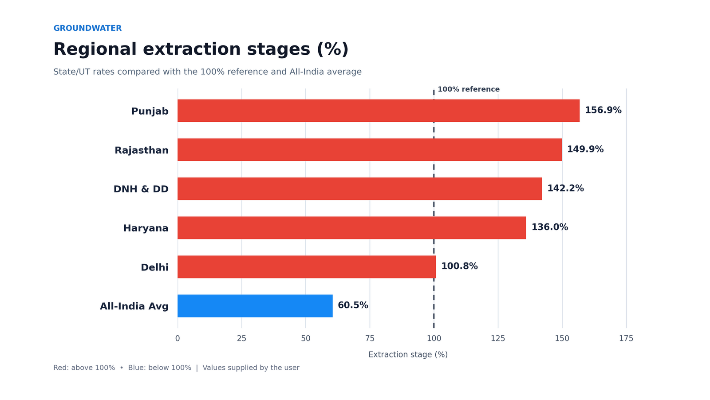
Executive Summary: A Nation at a Critical Hydrological Crossroads. Groundwater in India is no longer a hidden, limitless source of security; rather, it is a rapidly overdrawn account and nearing total exhaustion. According to the official assessment data, the National average stage of India Groundwater extraction is 60.5%. This national average seems to suggest there is still some breathing room in the system, but such aggregated data is a dangerous façade for what is occurring at a regional level.
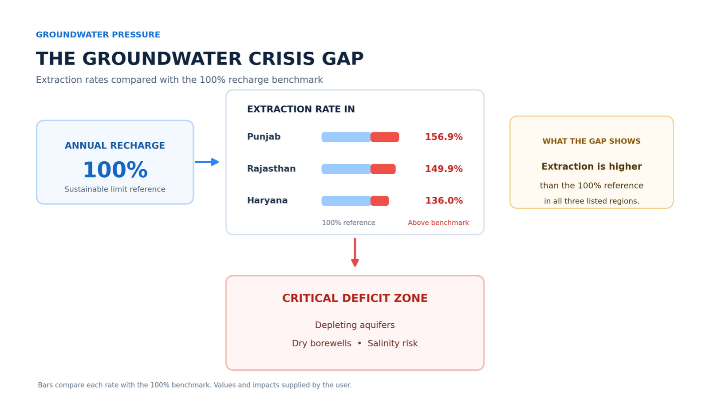
In the agricultural, industrial, and urban zones of the country, the rate of annual groundwater extraction is far greater than the replenishment rate:
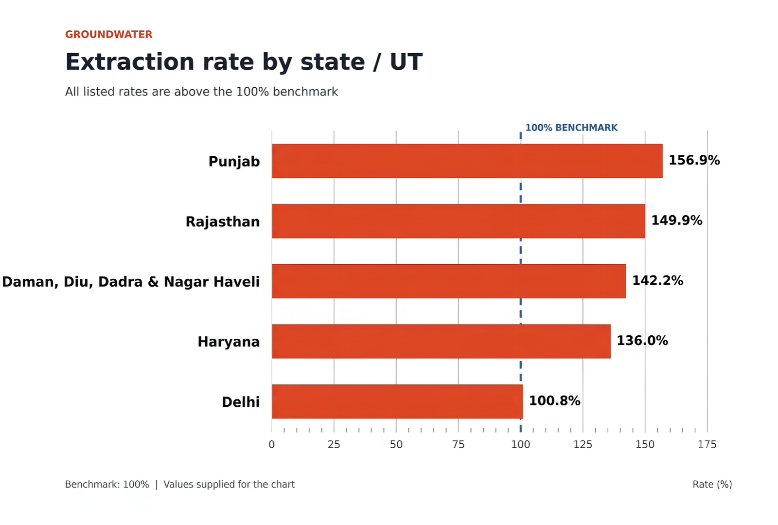
In these crucial areas, water is being drawn faster than it is replenished by rain or other natural processes. Relying on voluntary conservation pledges and public awareness campaigns has been unproductive. Traditional methods of water management are inadequate to meet the scale of the challenges.
To make a significant improvement in smart water management, India needs to change traditional methods by integrating digital technologies that can enforce water conservation and ensure that the required amounts of water are extracted, stored, and used. Conservation must be enforceable and cheap. The use of the internet of things (IoT), and artificial intelligence (AI), in combination with financial mechanisms such as water credits, makes conservation and protection of water resources enforceable and economically attractive.
1. Deconstructing the Crisis: The Fallacy of National Averages
Assessing water vulnerability in India requires an examination of how water is balance sheeted across various geographical, geological and economic sectors.
The Extraction Mechanics of Groundwater
The “stage of groundwater extraction” is expressed as:
Stage of Groundwater Extraction (%)=(Total Annual Extractable Groundwater ResourceExisting Gross Groundwater Draft for All Uses)×100
Once the figure goes beyond 100% a region is pulling more water than what gets naturally replenished and draws down on the dynamic ground water reserves, and eventually, even taps into fossil water resources that take millennia to form.
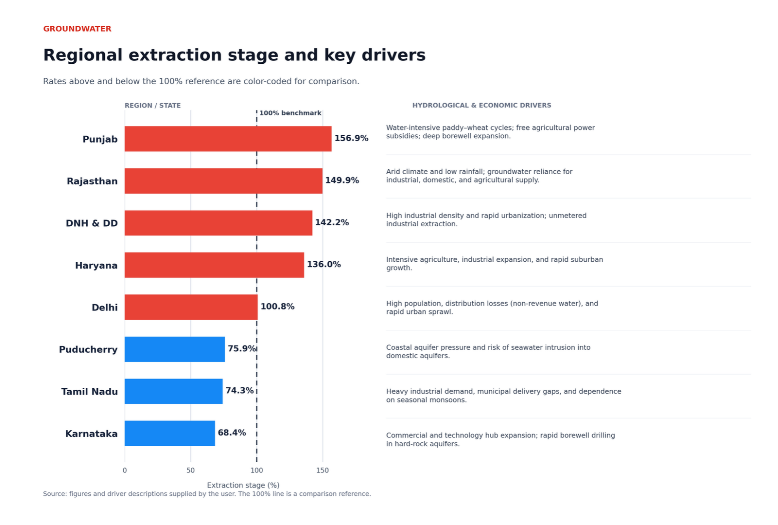
Regional Breakdown of Groundwater Depletion
| Region / State | Extraction Stage (%) | Hydrological & Economic Drivers |
|---|---|---|
| Punjab | 156.9% | Water-intensive crop cycles (paddy-wheat rotation), free power subsidies for agriculture and deep borewell expansion. |
| Rajasthan | 149.9% | Arid climate, low annual rainfall and reliance on groundwater for industrial, domestic and agricultural supply. |
| DNH & DD | 142.2% | High industrial density, rapid urbanization and unmetered industrial extraction. |
| Haryana | 136.0% | Intensive agricultural cultivation, industrial expansion and rapid suburban growth. |
| Delhi | 100.8% | Overpopulation, high distribution losses (non-revenue water) and rapid urban sprawl. |
| Puducherry | 75.9% | Coastal aquifer pressure and the risk of seawater intrusion into domestic aquifers. |
| Tamil Nadu | 74.3% | Heavy industrial demand, municipal delivery gaps and dependence on seasonal monsoons. |
| Karnataka | 68.4% | Commercial and technology-hub expansion, with rapid borewell drilling in hard-rock aquifers. |
2. Transforming Water Conservation: The Water Credit Market
The water credit is the metric that allows the market to assign value to water, making water management an economic driver instead of a regulated burden.
Water management is expensive and time consuming. Organizations have an incentive to transform water management from a regulated burden to an economic opportunity. To do this, the market needs a unit of measure. The Water Credit enables the assigning of value to water.
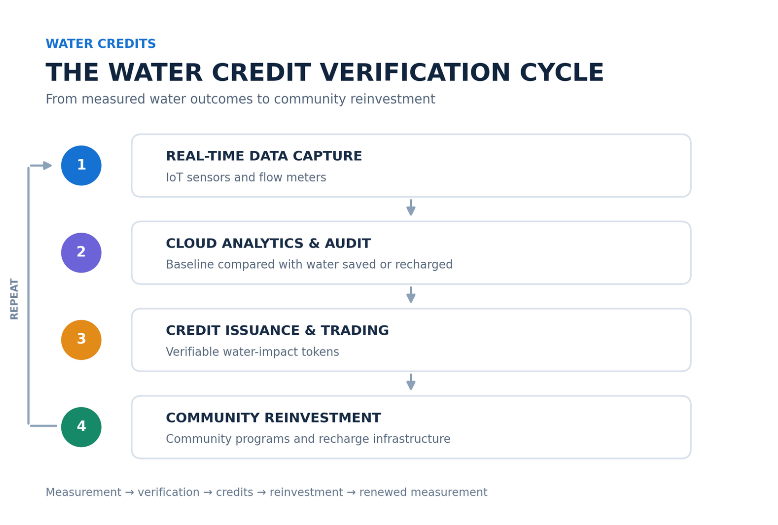
Water credits are similar to carbon offsets in the sense that they can monetize tools to certify a certain, verified volume of water saved, treated, or replenished to an aquifer.
Key Dimensions of Water Credit Architecture
1. Measurability
Manual logbooks and models for estimating water consumption are extremely vulnerable to fraud and error.
Smart water management systems employ a range of advanced sensors to automate flow measurement, including electromagnetic flowmeters, ultrasonic flowmeters, and pressure transducers.
2. Verifiability
Mechanisms for generating water credits require a digital audit trail. With the help of IoT and Cloud infrastructure,volumetric flow, usage patterns, and trends, as well as the quality of water (pH, TDS, BOD, COD) can all be measured to validate that recharged water meets health and safety standards.
3. Financial Viability
Verifying water savings allows a variety of customers to earn tradable credits including companies, residential societies, and local municipal bodies.
Industries can purchase water credits to achieve “Water Positivity” to meet their Corporate ESG initiatives and fund local groundwater recharge programs.
3. Digitizing the Infrastructure: How KarIoT Powers Real-Time Water Management
KarIoT has developed an end-to-end smart water management system that integrates field-level water infrastructure with cloud-based analytics. As a result, it provides real-time visibility across various residential, commercial, industrial and municipal sectors.
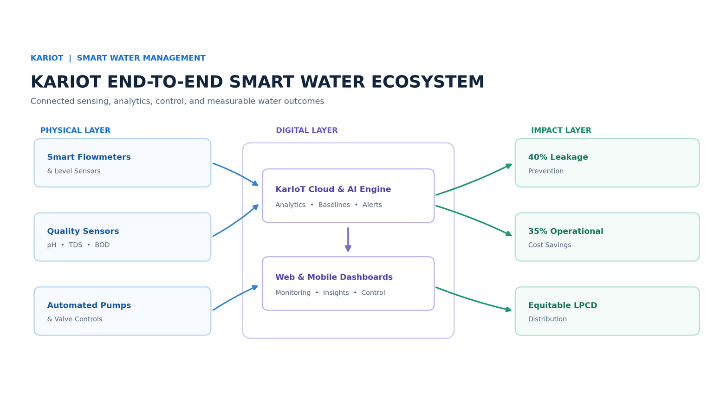
Core Technology Stack
· IoT Gateways & Sensors: Seamlessly interface with existing infrastructure to record flow rate, level, pressure, and chemical quality indicators.
· Cloud-Based SCADA Alternative: Eliminates complex, expensive legacy SCADA architectures, providing remote monitoring, unlimited user licensing, and cloud accessibility.
· AI-Driven Predictive Analytics: Analyzes consumption baselines, detects anomalies instantly, and flags leaks before they lead to structural damage or resource loss.
· Automated Valve & Pump Control: Automates motor runtimes based on tank capacity and scheduled usage, preventing tank overflows and reducing energy usage.
4. Sector-Specific Implementations & Operational Impact
A. Industrial & Manufacturing Operations
Stringent environmental laws have been enacted concerning the withdrawal of freshwater resources and the compliance of zero liquid discharge (ZLD) facilities.
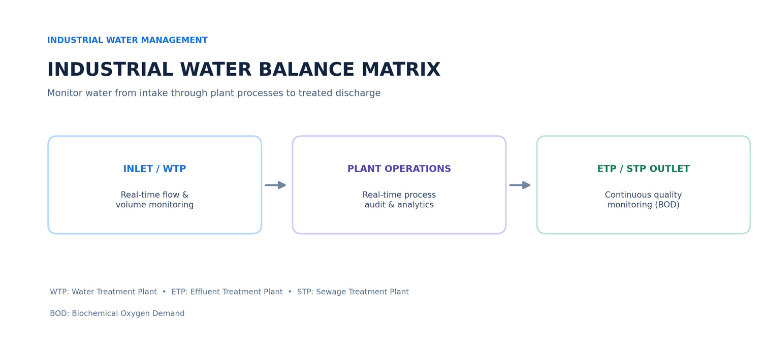
·Inlet/Outlet Balance Audit: Real-time tracking of water intake at water, effluent and sewage treatment plants.
·Quality Assurance: Automated monitoring of pH, TSS, BOD, and COD, ensures compliance with central pollution control standards.
·Cost Reduction: Automating shift reports and monitoring pump motor efficiency results in an average cost reduction of 30%.
B. Commercial Real Estate & Smart Infrastructure
Water Over expenditure by commercial real estate such as towers, malls & IT parks, is predominantly due to the reliance on private water tankers and manual water management.
· Tanker Lorry Automation: Digital tracking of tanker deliveries, automating and eliminating the need for manual billing.
· Overflow Prevention: Automated level sensors turn off pumps preventing water loss and structural damage.
· Green Building Certifications: Comprehensive data logging support Green building certifications.
C. Gated Communities & Residential Hubs
Water distribution in residential developments without water meters leads to inequitable water distribution and waste.
· Apartment Water Metering: Promotes water conservation and reduces water wastage within the household.
· Equitable LPCD Distribution: Monitors flow across zones to ensure LPCD to each resident.
· Leak Detection: Notifies facility management of any unusual increases in water consumption.
D. Municipal & Government Infrastructure (AMRUT 2.0)
Water Boards need end-to-end visibility of the entire water supply network to address non revenue water (NRW) issues.
· 360° Supply Chain Visibility: Tracks water from a reservoir to a district metered area (DMA).
· Rapid Response System: Accelerates the time to fault detection and correction in urban water supply networks.
· Efficient Distribution: Improves equitable distribution of water to all municipal zones.
5. Quantitative Impact Metrics – India Groundwater
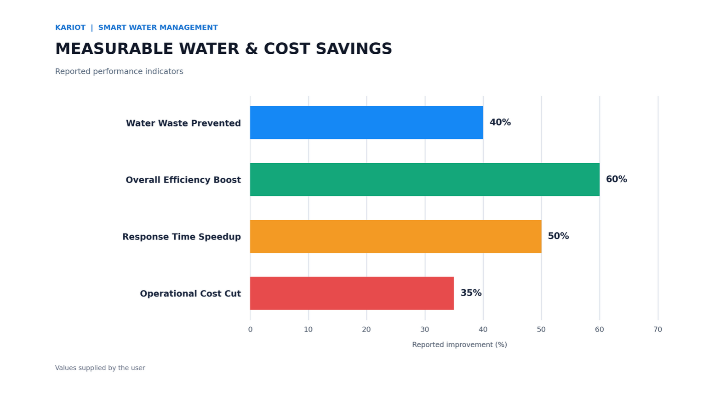
The economic & operational impact of digital transformation of water operations is measurable.
Operations Benchmark Improvements
- 40% decrease in water loss: Using preventative leak detection helps identify pipe damage and other issues before they worsen.
- 35% decrease in operational costs: Use of automated pump scheduling to optimize labor and reduce energy costs has helped reduce operational costs significantly.
- 50% faster incident detection: Timely notifications to maintenance teams help resolve issues before they lead to service outages.
- 60% decrease in SCADA infrastructure costs: Replacing outdated hardware with cloud and IoT technology helps significantly cut capital expenses.
6. India Groundwater – Strategic Roadmap: Building a Water-Positive Future
Transforming to long-term water sustainability will require staged transformation of industrial facilities, municipal water and wastewater treatment facilities, and commercial buildings.
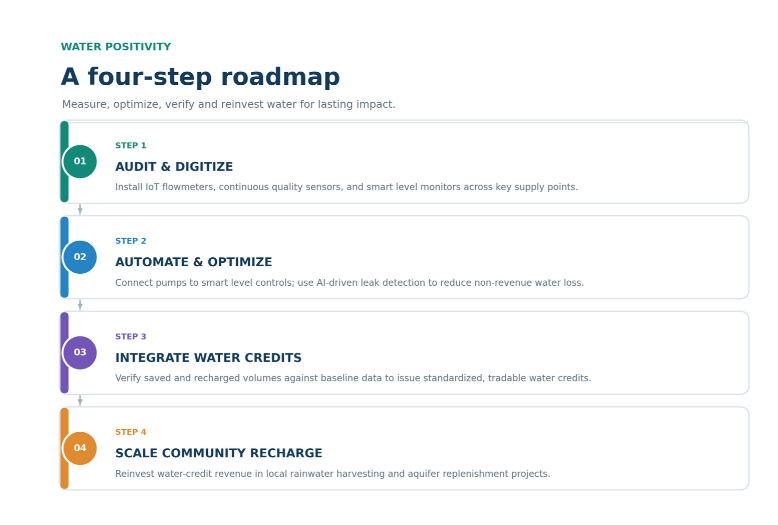
Phase 1: Audit and Digitization
· All major inlet lines, borewells, storage tanks and distribution zones have IoT smart meters installed to capture water flow data.
· Baseline data dashboards have been developed to capture total water volume, daily usage and water quality parameters.
Phase 2: Automated Optimization
· Install automatic tank overflow control systems.
· Leverages AI to detect leaks in piping networks and infrastructure.
· Cloud based dashboards to replace manual shift reports.
Phase 3: Financialization via Water Credits
· Assess facility water usage against industry averages.
· Measure and verify conservation impacts and local groundwater recharge.
· Monetize conservation impacts and local groundwater recharge via water credits through Terrablu Climate Technologies.
Phase 4: Community Aquifer Replenishment
· Utilizes water credit revenues to build community recharge infrastructures (e.g. percolation tanks and check dams).
· Use IoT to monitor recharge, to ensure aquifers are actually being recharged.
Moving from Over-Extraction to Measured Restoration: India Groundwater
Awareness alone won’t solve India’s groundwater crisis. Continuous extraction rates of over 150% in parts of Punjab and Haryana indicate that the problem is deeply structural.
By integrating real time Industrial Internet of Things (IIoT) platforms like KarIoT, and employing economic instruments like water credits, facility managers, businesses and government can transform water conservation into an accurate, transparent and financially rewarding strategy. Digitizing water infrastructure provides India the opportunity to leap from a state of over-extraction to a water positive state.
Is your Facility Ready to Digitize its Water Infrastructure?
Rewarding sustainability while improving water management is as simple as adding real time, IoT based tracking and leak detection to your facility. Just contact KarIoT for Smart Water Management or request an Infrastructure Audit from our Engineering Team.
Final Thoughts
India groundwater crisis requires more than public awareness; it demands measurable action, smarter technology, and long-term commitment. By combining IoT-based monitoring, AI-driven analytics, automated water management, and verified water credits, businesses, communities, and government bodies can reduce water waste and improve groundwater conservation.
Solutions like KarIoT can help organizations monitor consumption, detect leaks, and make informed decisions using real-time data. However, lasting progress depends on responsible water use, effective policies, and investment in rainwater harvesting and aquifer recharge. Moving from groundwater over-extraction to sustainable restoration requires turning reliable data into practical action today to protect India’s water resources for future generations.